
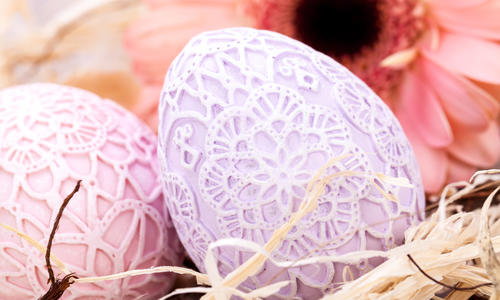
Traditionally, Easter eggs should be red, but people have long moved away from this rule. Craftsmen create a wide variety of designs on the shell of a natural egg or on the surface of a decorative one. There are often images of plants – leaves, flowers, fruits. But most often they depict symbols of Faith, Hope, Love, as on this ancient beaded egg kept in our family. It was embroidered back in the 19th century by a novice of the Kazan Monastery and given to my grandmother, then a six-year-old girl, for Easter. Eggs begin to be painted and painted on Maundy Thursday. Every housewife knows that you can color eggshells using strong tea, coffee, beet peels or cranberry juice and other natural dyes. If you first attach a sprig of parsley, dill, or an ornament cut out of tape to the egg, and then wrap it tightly in gauze, soft, slightly blurred contours will appear on the shell. Natural eggs are a perishable product. It can be very frustrating to break a small, one-of-a-kind handmade masterpiece. That’s why I prefer decorating artificial eggs. Ideal bases for dyeing, burning, carving and painting are forms made of wood, papier-mâché, plastic, foam and unfired clay. I won’t be able to paint a Khokhloma Easter egg or paint a canonical church plot on it, but anyone can paint a fantastic flower in gouache or watercolor! As a last resort, it is enough to make an applique or stick a suitable picture. And to make the egg look brighter, sequins, rhinestones and various sparkles are useful for a festive occasion. If you don’t have any time for handicrafts, store-bought plastic belts will help out. The crowns remain free – decorate them as you wish! Needlewomen are coming up with more and more new decoration techniques, and I have tried many. My love for everything growing has affected my hobby. Therefore, most of the designs and ornaments are on a “plant” theme. The flower can be depicted on a wooden egg using a burning device. These eggs are not that colorful, however, and they have their own charm. Some craftswomen knit egg cases from multi-colored yarn. For those who have not had to hold knitting needles in their hands, I advise you to wrap the egg with cotton, silk or woolen threads, gradually – drop by drop – fixing them with glue. What if you create an openwork mega-egg – a cage and put a chicken in it? Easter eggs decorated with ribbons, bindweed, wicker or woven braid look original. Leftover lace, brocade and velvet are suitable for this purpose. Such materials look luxurious in combination with beads, sparkles and beads. You can make an elegant souvenir if you put beads on a string and fasten them to the egg with colorless glue – neatly, turn by turn, or in “strict disorder.” Making beaded Easter eggs is perhaps the most difficult, but, in my opinion, the most interesting activity. The design on that ancient egg is embroidered with tiny beads. Now the technique has been simplified – the craftswomen braid the shape, starting work from the middle or from the top. To begin with, you can make an openwork belt, and after gaining experience, weave a cheerful, bright, colorful egg from randomly selected multi-colored beads. More complex patterns can be created independently, but patterns for cross stitch are also suitable (each cross corresponds to one bead). In the publication Easter eggs made of beads you will find a diagram and detailed instructions that will help you make such beauty with your own hands. Mosaics are laid out from any suitable materials – from painted shells, plant seeds, cereals and pasta to ceramics and shredded computer disks. The latter, in my opinion, look a little rough, but, as an option, interesting. More advanced needlewomen collect eggs from modules in the quilling style. It turns out very elegant! Mastering this art is still in my plans. And the art of engraving on shells seems completely unattainable to me. This requires special equipment. And I really want to try it! Aerobatics. Photo from the site tech.obozrevatel.com To make a pysanka, you need not only to be able to draw, but also to know all the subtleties of folk ornaments. Therefore, I simply paint on the shells everything that God puts on my soul, and I console myself with the fact that “paintings” in the old days were made specifically for giving. And the eggs I made (I can brag!) live not only in the homes of Kazan residents, but also in many cities of Russia, and also in America, Germany, Japan… I also have in my collection eggs given by friends for Easter. Unfortunately, almost none of them are homemade, but that’s okay. Any egg is precious for Christ’s day! I would like to give you, dear friends, this festive composition. Christ is risen!
Source
82

previous post