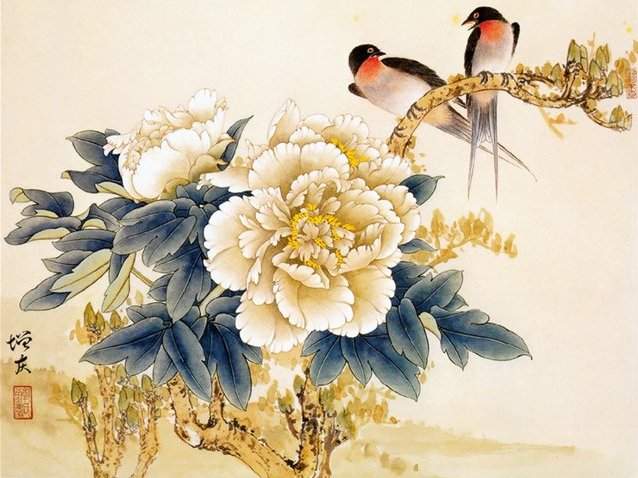
Wall painting in the interior is one of the best techniques for creating an individual and characteristic decor. However, it can both decorate a design and ruin it completely; it all depends on the harmony of the design relative to the overall composition of the interior and, of course, on the quality of the painting.
To begin with, you need to decide what you want. If you have settled on a complex pictorial or graphic motif, you need to contact professional artists after familiarizing yourself with their portfolio.
An alternative that you can do yourself is stencil painting, a template for which can be ordered from the same artists or found on the Internet. You can print the template on thick paper, cardboard or oracal film. It is best to apply paint through a stencil using a sponge. Of course, the stencil design will be flat – that is, without traced volume, gradations of light and shadow, color transitions, however, in interiors such a format looks stylish.
In general, when decorating a room, you should abandon realism in favor of laconic stylization; especially stylized images are suitable for modern wall painting. In this case, the picture can be quite bright; pure colors are preferable. You can add a little gold, silver, bronze shades, and for greater expressiveness of the design, use a dark outline (not necessarily black, you can go with brown or dark blue).
Types of wall paintings
Based on the location and role in the interior, several types of wall painting can be distinguished.
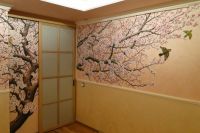
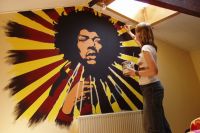
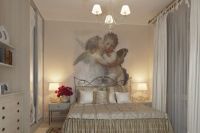
- An image is a painting with a specific plot and motif. Most often it occupies the entire area of the wall or is located in the center. It is worth saying that complex compositions with many details and color transitions are not very appropriate in interiors (unless we are talking about the interior of a nursery). Wall painting is primarily a design element, and not a self-sufficient work. It is best to choose compositions with one dominant figure and a minimalist color scheme. A good example of minimalist images is wall painting in the Japanese style, imitating traditional graphics with images of cherry blossom branches, chrysanthemums, and graceful landscapes.
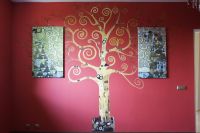
- A painting that actively interacts with other elements of the interior – the line of the drawing emphasizes the internal architecture of the room, frames doors and furniture. It can be a floral or geometric pattern, ligature, silhouettes of birds, butterflies, or you can also draw a picture of tree branches along the desired contour. For example, a tree with photographs or small framed paintings “hung” on its branches will look interesting.
- Frieze painting, a horizontal ribbon pattern that runs along the entire wall, most often along its upper part, at the border with the ceiling. The frieze will help emphasize the atmosphere of neoclassical interiors, as well as designs with an ethnic flavor – it all depends on which motif you choose. In this case, pay attention to the ornaments characteristic of antique (for neoclassical interiors and Mediterranean decor) or a certain national tradition. By the way, it is the ornamental frieze that will help to embody wall painting in an oriental style, for example, Chinese.
Materials for wall painting
First, you need to prepare the wall for painting – putty it well and prime it with white water-based paint. For applying a picture – this applies to stencils and images made by hand – a water-based emulsion and a set of acrylic colorants are also suitable.
For hand-painted painting, you need to get a set of hard brushes of different sizes; By the way, they won’t hurt to correct the stencil motif.

|
|
|

|

|
|
|
|

|