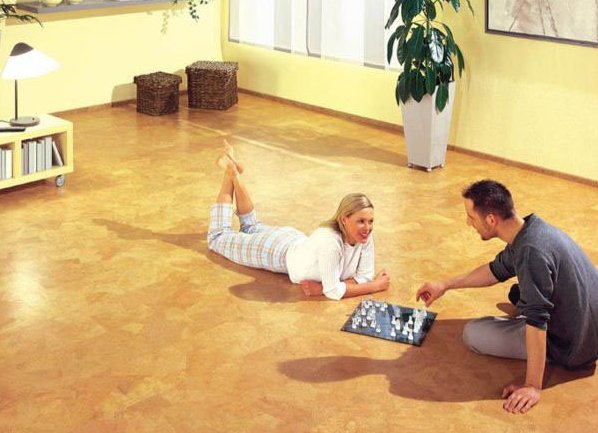
To a large extent, the comfort of staying in a particular room depends on the quality of the flooring. Therefore, nowadays, due to its unique properties, this type of finishing material for the floor, such as cork, is gaining increasing popularity. What is unique about this material? First of all, this is, of course, its environmental friendliness. Cork, as a finishing material, is made by pressing crushed oak bark of the same name, that is, it is an absolutely natural material. In addition, you can add such an interesting detail, further emphasizing the environmental friendliness and naturalness of this material – cork trees are never treated with chemicals, herbicides in particular.
Cork – floor covering
Cork flooring is available in two varieties, differing in the installation method. The first type is an adhesive cork covering. This floor covering is a tile made of cork, which is laid (glued) onto the surface to be decorated using glue. Since the sizes of such tiles vary and can be selected depending on the design idea (despite the fact that the thickness of such a coating is strictly constant), its use provides ample opportunities for creating original floor compositions. Another type of cork flooring is floating floors. They are panels that are not glued to a base, but are connected to each other using tongues and grooves, like laminate panels. Just like laminate, panels of cork floating floors can be connected to each other using the “click-clack” principle, that is, by inserting a ridge on one panel into the groove of another panel, or by gluing groove-tenon joints. Both types of cork flooring can be additionally coated with varnish or vinyl film, which further improves the performance of the cork layer.
After reviewing the types of cork flooring, a reasonable question may arise about how to choose the right floor covering.
To answer it, you should familiarize yourself with all the advantages and disadvantages of cork as a finishing material.
Cork on the floor – pros and cons
First of all, it should be said that the price level of this coating is affected by the specificity of obtaining the raw materials. This is perhaps one of the most significant deterrents to the massive use of cork for interior decoration – cork floors have a fairly high price. You can also point out the following points that have a negative impact on the use of cork:
- Although the mechanical strength is sufficient, the cork coating is not resistant to tearing;
- protection from direct sunlight is necessary (the coating may fade);
- with prolonged exposure to pressing force (for example, furniture legs), dents remain on the cork.
But, all these disadvantages are more than offset by the mass of positive qualities of cork covering. In addition to the fact that cork, as already mentioned, is an environmentally friendly material, it also has bactericidal and antistatic properties. This flooring does not absorb odors and moisture, and is resistant to household chemicals and fire. Therefore, cork, as an option for covering the floor in the kitchen, can be considered an almost ideal material. The positive properties of cork also include high heat and sound insulation. And the fact that it is almost impossible to slip on a cork floor makes it possible to lay cork (only adhesive cork tiles) on the bathroom floor.

|

|

|

|

|

|

|

|

|