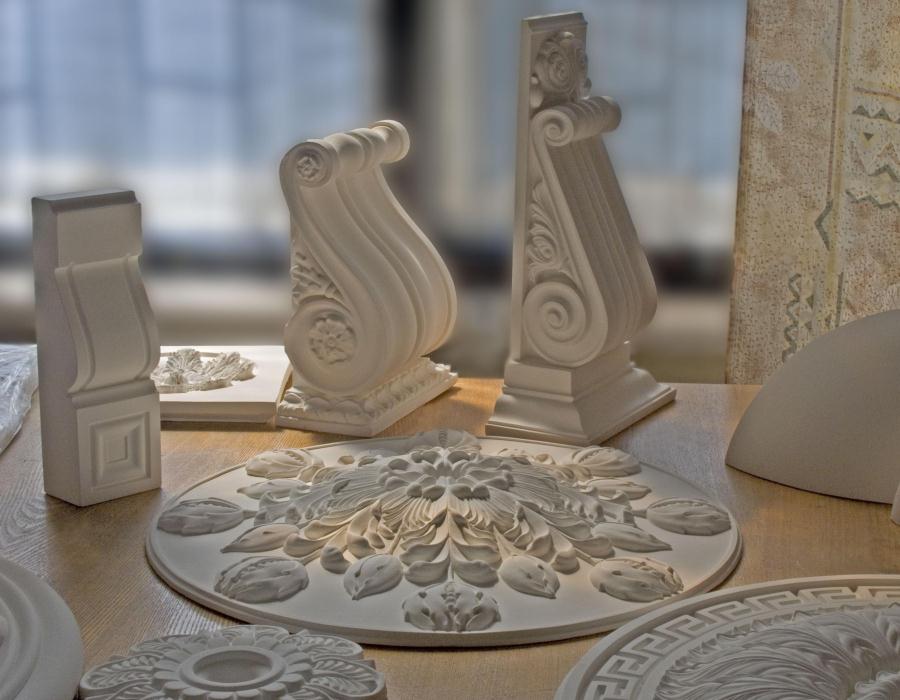
The progress of construction technologies does not stand still – every day more and more new interior decor options appear. Many types of wall decoration have gone into oblivion, but there are methods of decoration that have retained their relevance through the centuries. This is decorative stucco in the interior, which was used to decorate majestic ancient temples. Nowadays, you don’t need to be a fabulously rich person to decorate your home with stucco. According to the stereotype, relief decorations on the ceiling, walls and facades are suitable only for classic interiors. In fact, modern stucco style has gone far beyond this rule. Designers often use this type of wall decor to make the strict geometric shapes of modern designs more attractive. In addition to performing an aesthetic function, stucco decoration will help place accents in the room. With the help of stucco in a modern interior, you can visually divide large rooms into functional zones by decorating the ceiling with a three-dimensional pattern.
What is decorative stucco in the interior made of?
Nowadays, gypsum and polyurethane are used to make stucco decoration. Despite the differences between these two materials, stucco molding practically does not differ in appearance or quality.
If you want decorations for your home to be of high quality, durability and environmental friendliness, then plaster stucco in the interior this is exactly what you need. Stucco decoration made of plaster is a classic option that has been relevant for hundreds, if not a thousand, years. Gypsum is quite resistant to moisture, so the decorations on the walls will not lose their color and will not begin to deteriorate after a few years. Gypsum stucco decoration is easy to install and reliably serves for many years. The only drawback is the heavy weight of the material. This should be taken into account during installation – not every structure can withstand a large composition of decorations. And gypsum stucco in the interior of an apartment will cost you a lot, but the end result will not make you regret the money spent.
Polyurethane stucco molding – This is a relatively new phenomenon in interior design. This material has a number of advantages compared to similar gypsum products. Thanks to the plasticity of polyurethane, it is possible to produce a decorative composition of any complexity, and modern technologies make it possible to achieve maximum quality of the design. And there will be no difficulties during installation, since the material is light in weight. You can even decorate a wall with polyurethane stucco near a hot lamp without fear of the material melting or causing a fire. In addition to the above advantages, polyurethane stucco decoration is easy to paint, unlike plaster.
Interior design with stucco
Interior decoration with stucco molding will give you the opportunity to transform an unsightly standard home into an elegant and original one. Before you make a purchase of stucco decoration elements, you should consider one important rule – voluminous decorations require a lot of free space. You should not decorate an already narrow passage with columns or decorate a chandelier with stucco molding if the ceiling height is less than three meters.
The ideal place for stucco decoration is a spacious living room. Considering the variety of designs and technologies for their production, you can choose voluminous wall decorations for almost any design style. The interior of a living room with stucco will always delight guests and delight the eyes of the owners of the house.
The stucco molding fits perfectly into the interior of the bedroom. Fairy-tale scenes, flowers or abstractions will make this room an ideal place to relax.
 |

|

|

|

|

|

|
|

|