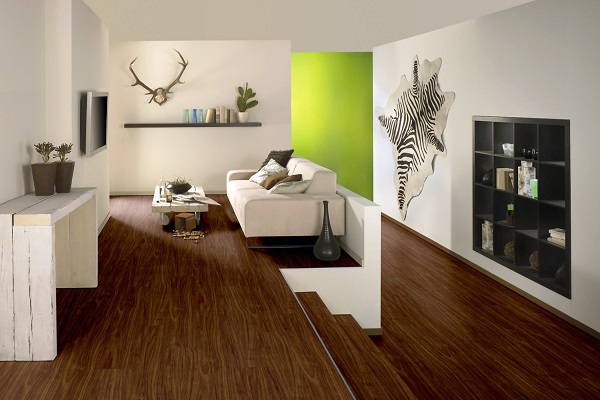
Vinyl flooring is a relatively new material that has proven itself from the best side.
Vinyl flooring combines the best qualities of linoleum, laminate and wood. It can withstand very high loads, so it is often used in living rooms, retail and office premises, medical institutions and other places with large crowds of people.
Vinyl coating composition
Vinyl flooring is a multi-layer coating, which provides it with high wear resistance and a beautiful appearance.
The topmost layer is a vinyl film covering. This layer is completely transparent. It protects the surface from mechanical and chemical damage, shock, scratches and friction. The thickness and quality of the vinyl film determines the wear resistance class of the coating.
Under the top layer there is a pattern imitating a natural material, abstraction or surface of any color. A clear design is applied using heliogravure or screen printing. A special varnish or film is applied over the design to protect it from ultraviolet rays.
The next, middle layer is made of pressed quartz chips and plasticizer. It gives vinyl coating strength, rigidity and elasticity.
The bottom layer is a vinyl backing (PVC). It stabilizes the vinyl floor, dampens all vibrations, so when walking on this surface you can’t hear steps at all.
All layers are connected to each other using the hot pressing method. It is worth noting that due to the addition of plasticizers and stabilizers, vinyl coating cannot be called environmentally friendly and natural.
Types of Vinyl Flooring
- Vinyl flooring self-adhesive tiles – characterized by a square or rectangular shape of any size. The surface on which the glue is applied is hidden under the protective paper layer. All you need to do is remove the paper and glue the entire surface of the tile to the base.
- Vinyl tiles with locking joint on self-adhesive tape. It does not require gluing over the entire surface; you just need to connect the tiles together.
- Vinyl roll sheet. It requires complete gluing using special glue.
- Vinyl floor tiles that must be glued using a special adhesive. The aesthetic appearance (the ability to create an individual pattern) and the strength of adhesion to the base depend on what type of vinyl flooring you choose.
Advantages of vinyl flooring
The material, first of all, has very high wear resistance and strength. It is not afraid of shocks and scratches, as well as high loads. It will not crumble or crack, and will not leave dents from heels.
Due to its absolute water resistance, vinyl coating can be actively used in the bathroom or in rooms with high humidity.
Vinyl floors are distinguished by their decorative qualities. This material is beautiful and sophisticated.

Vinyl flooring is non-stick, non-slip, anti-static and easy to clean.
You can lay vinyl flooring yourself without special preparation on any surface – tile, concrete or wood floor. Installation is also possible on surfaces with unevenness and height differences.
Laying vinyl flooring does not require a lot of time, binding materials and installation tools. Vinyl floor tiles have stable dimensions and characteristics, which eliminates the appearance of cracks.