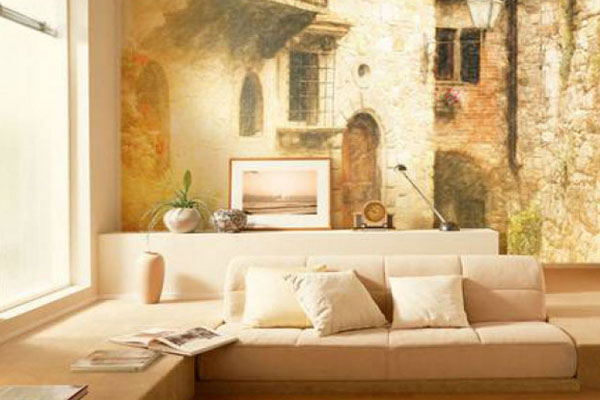
Frescoes on the wall are not a cheap pleasure. But the decoration of the room turns out incredibly impressive and expensive. As an alternative, modern technologies offer an excellent tandem in the form of frescoes and photo wallpapers. Photo wallpaper in the form of a fresco on the wall is used both as an accent paired with regular wallpaper and for finishing all walls.
Photo wallpaper for a fresco – what are they?
What are photo wallpaper murals? Essentially, this is a large piece of paper with some kind of design, but the application technique is special. It is precisely because of its texture that this wallpaper is used not only for finishing walls and ceilings, but even for updating old furniture or doors.
Photowall-paper frescoes are obtained quite similar to real frescoes due to the application of a special varnish. When it dries completely, microcracks appear on the surface, which give the effect of an ancient fresco. The most important thing in applying varnish is speed and accuracy, since the layer must be uniform.
Photo wallpaper in the form of frescoes in the interior
Modern designers have long abandoned stereotypes and stopped decorating exclusively one wall or part of it with photo wallpaper. Of course, the option of using canvas in the form of a painting or partial wall decor remains in demand. But there are also grandiose projects where fresco-like photo wallpapers are glued to the wall and even to the ceilings. In most cases, these are antique, unobtrusive subjects, diluted with halftones. Fresco-like photo wallpapers allow you to recreate ancient castle interiors. In this case, subject paintings in darker colors are suitable. If you don’t want to load the atmosphere too much, then use the so-called picture formats. These are small images: reproductions of famous paintings, modern famous motifs, images of the most famous landmarks of the world. Frescoes and photo wallpapers are used to design halls, offices and spacious hallways. Less often they can be found in kitchens or balconies (if the latter are used as an extension of the room).
With this design, it’s worth thinking about the rest of the room’s filling in advance. For example, furniture should be chosen from natural wood, preferably with visible wood texture. The fresco looks especially good when paired with heavy, expensive textiles, not necessarily dark in color. And of course, this is an ideal solution for a classic interior, but even in modern designs there is a place for a fresco.

|

|

|

|

|

|

|

|

|