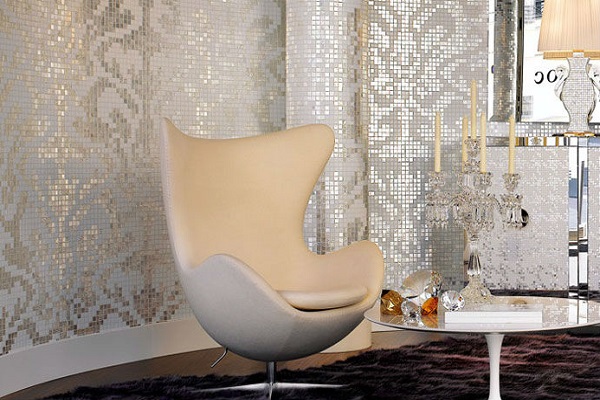
Decorating surfaces with mosaics cannot be called a new or original technique. The first tile patterns were created back in the Middle Ages, but over time, of course, such luxury became possible to reproduce in almost any home. The secret of the centuries-old popularity of this material lies in three simple characteristics: quality, beauty and practicality.
Over time, decorative mosaics have ceased to be used only for walls; now, with ingenious patterns, you can decorate the floors and facades of houses, paint furniture with bright pieces and create paintings from them. We will talk about all the possibilities of using this universal material further.
Decorative mosaic tiles in the interior
As we have already noted earlier, mosaic is a thing that will find a place in the interior of any room, regardless of its stylization. Patterns of tiny tiles have long left the confines of bathrooms, moving into living rooms, bedrooms and kitchens. From mosaic tiles you can make an easy-to-use apron for the work area of the workshop, or lay it on a fireplace or decorative columns. In the bedroom, mosaic patterns can either complement or completely replace the headboard of the bed. To decorate your living room, you can choose tiny mirror tiles of any shade; for example, silver mirror mosaic inserts laid out on a gray background will always look good. By the way, mirror pieces of acrylic mosaic often do not even need to be secured using additional means, since they are sold on a self-adhesive basis.
Separately, we should touch upon the topic of floors made of decorative mosaic tiles. Mosaic floors can completely complement the decor of the walls, or they can be bordered with full-size tiles for an even greater decorative effect.

|

|

|
Decorative PVC panels for mosaics
The manual laying out of each mosaic element has been replaced by ribbons of tiles on a grid, which can be easily attached to the wall in one piece, but despite the ease of installation and operation, the prices for such decor are high. A much more budget-friendly solution is polyvinyl chloride tiles decorated with mosaics. A PVC sheet with an embossed pattern is glued to the walls using a special solution, and the joints with the floor and ceiling are decorated with plastic panels. In addition to the pleasant price, it is also worth noting the water resistance of this material, as well as the fact that during installation you do not have to bother with grouting the seams.
In addition, there are a huge number of PVC mosaic design options available on the market: from classic blank canvases, to bright colored assortments and decorative mosaic panels with abstract patterns.
The only disadvantage of a decorative PVC mosaic panel can be that it can only be laid on flat surfaces – on too curved geometry the slabs do not attach well and look unnatural.

|

|

|
Decorative mosaic for the bathroom
Whatever one may say, mosaic decor can most often be found in the design of bathrooms, saunas and swimming pools. In such rooms, the versatility of color and mirror reflection builds a direct association with drops of water and other naturalistic motifs. You are free to mosaic the entire room from floor to ceiling, focus only on the bath/shower area, or modestly outline the perimeter of the room with a narrow apron made of pieces of tile – it will look chic in any case. The combination of mosaics with large tiles in contrasting shades also looks original. And to make your decor look more organic, do not forget to purchase decorative plaster in the color of the mosaic, waterproof, of course.

|

|

|