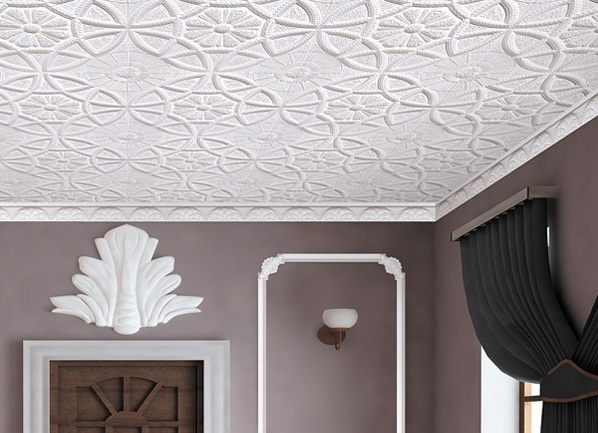
Having set yourself the task of quickly and without significant material costs to improve or update the appearance of the ceiling, do not discount the option of using foam boards as a finishing material.
Finishing the ceiling with foam tiles
First of all, a few words about the varieties of such finishing. The tiles, depending on the production method, can be pressed (thickness about 7 mm), injection (thicker – 14 mm) and extruded. In shape, foam ceiling tiles are presented in the form of squares with a side of 50 cm or rectangles with side dimensions of 16.5×100 cm. Of particular note is the wide selection of tiles in terms of surface design – absolutely smooth, textured, with a convex pattern. This variety provides ample opportunities for decorating the ceiling in your own individual style.
Foam tiles also have a number of undeniable advantages:
- ease of installation. Pasting ceilings with foam plastic tiles is carried out by applying glue (special, designed for working with foam plastic; universal or PVA) to the entire surface of the tile and then pressing it to the ceiling. The tiles can be mounted (glued) to any surface – from concrete and fiberboard to plaster and plaster;
- its low weight allows it to be used for finishing ceilings even with low load-bearing capacity;
- The tiles are resistant to external influences (primarily moisture) and have excellent sound and heat insulating qualities.
Since no material is perfect, foam tiles are no exception. But its disadvantages (the ability to turn yellow with prolonged exposure to sunlight, the impossibility of decorating the ceiling with built-in lamps due to the small thickness of the tiles) are more than compensated for by its low cost.
But in general, foam boards are a good alternative to suspended and suspended ceilings.

|

|

|

|

|

|

|

|

|