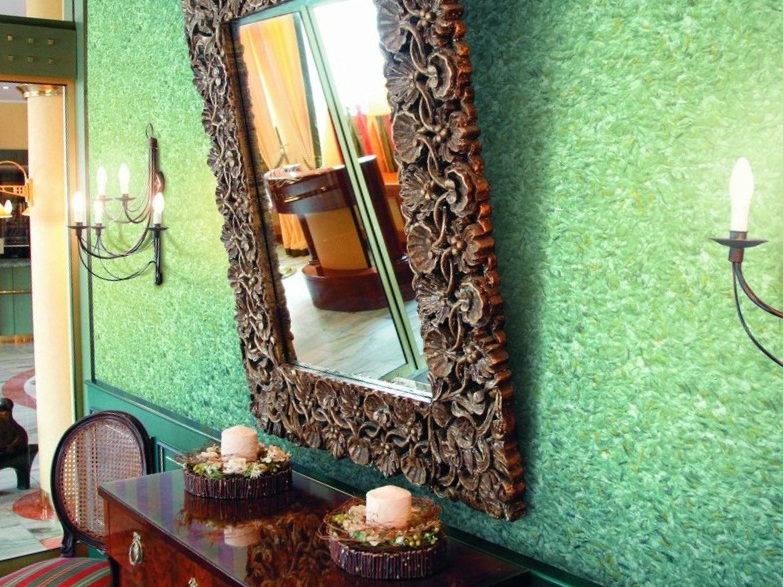
The very name of this material tells us that it practically replaces the familiar plaster and roll wallpaper. This includes cellulose and KMS glue used for binding, as well as silk fibers and dyes, which allows you to create an attractive and pleasant coating, both in appearance and to the touch. You can see that in terms of composition, this substance is in many ways reminiscent of paper wallpaper, but in terms of the method of application to the wall, working with liquid wallpaper is more like plastering walls.
Liquid wallpaper – what is it?
What we usually need for plastering work is a trowel, a float, a spatula, a level, a bucket and a dry mixture. The same tools are required for a master who works with liquid wallpaper. But if the plastered surface is a dull, uniform-colored wall, then in our case you can create various applications or even real paintings at home.
A standard package for liquid wallpaper consists of the following main components: dry KMS glue, fillers (colored granules or powders) that perform decorative functions, and base fibers (cellulose and silk). All these components can be packaged in separate packages or already mixed together. Before adding water to the composition, it is necessary to fluff the mixture, making sure that no lumps remain.
Briefly about applying liquid wallpaper
There are no harmful components in this material, so you can stir the composition with your hands. Experienced craftsmen say that the mixer can even damage long fibers, which does not have a very good effect on the appearance of the treated surface. In order for the glue to soften well, it is advisable not to touch the mixture soaked in water for 6-12 hours. You need to mix enough material to cover the entire wall; it often happens that transitions are visible after drying. Therefore, it is better to prepare a little extra solution. If the wall is well prepared and smooth, then a kilogram of the mixture is enough for 3-4 m² of surface.
Now let’s talk about how to properly apply liquid wallpaper, especially since it’s not difficult to do it yourself. Place the required portion of the material with your hands or a spatula on the surface and rub it over the wall. The layer thickness should not exceed 3 mm. Although it is better to read the instructions, depending on the composition, sometimes the requirements may differ slightly. After you have processed approximately 1 m² of wall, wet the float in water and smooth the surface, removing any grooves or lumps.
If you have some material left, it is better not to throw it away. It will be useful for repairing damaged areas. Pack the wet solution in a thick plastic bag, and in this form it will keep well for several weeks. To give such wallpaper strength, some craftsmen add a little colorless water-soluble acrylic varnish to their composition. But still, in a damp room (kitchen, bathroom), it is better to use special waterproof compounds, the work with which is practically no different from what was described above.
Design of liquid wallpaper in the interior
The good thing about an interior with liquid wallpaper is that there are no visible joints on the walls, the surface is level, and all components are absolutely safe. The surface treated with this substance breathes, repels dust and does not fade under the influence of ultraviolet radiation, like paper. The cost of such a coating is still high, but you can create real beautiful and durable paintings on the walls. Apartments in which compositions with silk fibers were used for surface finishing look especially interesting. It seems that the walls are upholstered with expensive fabric.
Interior design with liquid wallpaper can be varied. The fact is that you can successfully use both a single-color dye and a combination of colors. Therefore, there are craftsmen who are able to paint real canvases with intricate patterns on the walls. But you shouldn’t combine liquid wallpaper with other materials; it’s better to decorate the entire room with it. Silver or gold threads, which are mixed into some compositions, add sophistication and originality to the interior. If you know what liquid wallpaper is, you can easily create accents using color transitions, highlight the desired areas, making your room unique.
|

|

|

|
|

|
|

|

|