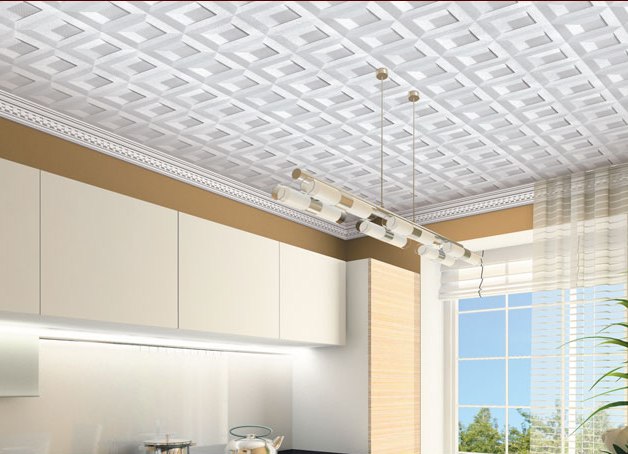
Finishing the ceiling is one of the most important stages of renovation in an apartment. Various finishing materials can be used here, from ordinary wallpaper to exotic aluminum profiles. However, most options require preliminary leveling of the surface, which takes a lot of time and effort.
If you want to make repairs as quickly and inexpensively as possible, then ceiling tiles will be the best option. Its cost is relatively low, and the installation process is so simple that even a woman can handle it.
Tile properties
Ceiling tiles are made from expanded polystyrene, which is more commonly called polystyrene foam. This material is popular because of its low price and variety of patterns on the surface: imitation of marble, wood, iron and various colors.
To create sound insulation, fiberglass slabs mixed with starch can be used, and for eco-style apartments, wood slabs can be used. However, expanded polystyrene remains the most affordable and popular material, which is consistently in high demand. This is due to the properties that foam tiles have, namely:
- easy to clean with any non-abrasive means;
- installation takes only a few hours;
- before installation there is no need to hide irregularities and remove old putty;
- unlike plasterboard and suspended ceilings, tiles do not reduce the height of the ceiling;
- in case of severe contamination, it can be painted with water-based paint;
- easily dismantled.
The tiles have several disadvantages, but they are quite significant. The biggest disadvantage is that it is made of flammable material, which affects the fire safety of the house. In addition, the seams at the joints stand out well, which spoils the aesthetic appearance of the room.
Which ceiling tile is better?
Depending on the type of surface, the following types of ceiling tiles can be distinguished:
- Laminated ceiling tiles. This is the most expensive coating option, which has a special coating – lamination. Thanks to this, the surface has a light glossy tint and a pleasant smooth texture. Lamination allows the boards to be used in rooms with high humidity, where the ceiling often needs to be washed.
- Seamless. It has smooth edges without edging, so it is easy and pleasant to glue. The areas where the tiles join are almost invisible, which allows you to create the illusion of a smooth, uniform ceiling.
- Mirror. For production, plastic is used, the front side of which is covered with a mirror layer. Its main feature is the visual expansion of small spaces.
Which of these options should you choose for your apartment? Here you need to be guided by the desired visual effect. If you want to surprise your guests with an unusual corrugated ceiling, then use a laminated board, and if you want to create the effect of a suspended ceiling, then seamless products are suitable.
We design ceiling tiles
Installation of the products is quite simple. Glue is applied to the inner surface in a thin X-shaped layer. After this, the tile is pressed against the ceiling for a few seconds. To avoid deep seams, the slabs are fastened close to each other.
Now you need to decide in what order the tiles will be placed on the ceiling. The classic option is installation parallel to the walls. If you want to show your individuality, you can stick the ceiling tiles diagonally. In both cases, installation must be carried out in orientation to the arrows located on the inside of the slabs. This will help to correctly align the pattern and evenly cover the entire surface of the ceiling.

|

|

|

|

|

|

|

|

|