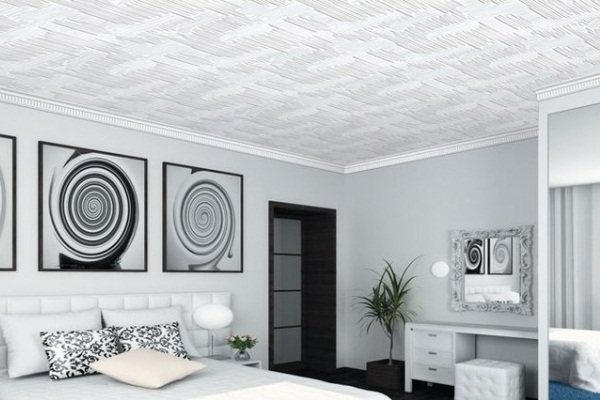
Man has always strived and will strive to decorate his home. Previously, building facades and interior decoration were distinguished by the presence of expensive wood species, unusual stones and luxurious marble. Today, natural, expensive materials are easily replaced with cheaper synthetic ones. But, you must admit, analogues do not always look worse than the originals, and if performed correctly, they serve with dignity for many years.
The design of modern interiors is not complete without the use of foam decorative elements. The advantages of polystyrene foam include its non-toxicity, lightness, and ease of manufacture and use. The cost of foam products is much cheaper than natural materials.
Polystyrene foam is often used in the manufacture of molded cornices, arches, shelves, window sills and columns. But some of the most popular foam products are ceiling and wall panels. Today we will talk about them in more detail.
Types of ceiling and wall panels
Foam ceiling panels are available in square, rectangular, diamond and hexagonal shapes. The front part of the slab can be simple or laminated, smooth or embossed, white or painted. Thanks to various technologies, the facade of the panel acquires a wide variety of textures and textures – wood, stone, fabric, leather.
Foam ceiling panels also differ in their manufacturing method. They are stamped, injection and extruded.
Stamped slabs have a coarse grain and can form large gaps if measured incorrectly. Their thickness is 6-7 mm, they are made by pressing. Such ceiling panels are usually white, and they can be given a tint by painting them with water-based paint. This type of additional finishing only has a positive effect on the performance properties of the slabs. Another advantage of a stamped product is its low cost.
Injection slabs are a wonderful material for finishing walls and ceilings in kitchens and baths. They have water-repellent and noise-absorbing properties, which in turn increases the cost. Their thickness is 9-14 mm, they are made by casting and baking raw materials in molds.
Extruded slabs are the most durable of all types of ceiling panels. Plus, they have a wide range of colors, which allows them to be used to implement absolutely any design solutions. The only drawback is the high cost of installation.
Advantages and disadvantages of foam ceiling panels
Advantages:
- Ceiling tiles can be mounted on absolutely any surface – bare concrete, painted wall or wood shavings.
- Foam tiles can be installed even near radiators and other heating objects. Since the radiators heat up to a maximum of 80 degrees during the heating season, the presence of ceiling-wall panels next to them is absolutely safe.
- The service life of high-quality foam panels reaches decades.
- Foam boards have soundproofing and thermal insulation characteristics.
- Fast, simple and cheap installation.
- Polystyrene foam is an environmentally friendly material.
- Affordable price.
Flaws:
- The white color of the tiles turns yellow over time.
- Vapor tightness.
- Polystyrene foam is a non-flammable material, but melts easily. Therefore, it is not recommended to install lamps close to ceiling panels.
- Ceiling tiles are fragile and can easily be damaged.
We hope that this information was useful to you and made it easier to choose a material for finishing the ceiling.

|

|

|

|

|

|

|

|

|