Despite the widespread popularity of Roman curtains and blinds, ordinary curtains are not losing ground. Therefore, manufacturers are improving not only the fabric itself, coming up with new and effective materials, but also the cornices on which it is attached. In this article we will look at a very interesting type of product that allows you to create the feeling that the fabric seems to be flowing down from the ceiling. Of course, we are talking about the ceiling cornice. They are made from wood, aluminum, brass, copper. The most widespread products are now made from plastic; we will consider them in more detail in this article.
Advantages of plastic ceiling curtain rods
- The main advantage of this type of product is the ceiling mount. A concrete surface or plasterboard structure is best suited for this.
- There are plastic curtain rods for ceiling curtains, single-row, double-row or even three-row. The presence of several grooves makes it possible to solve many design ideas
- The length of the cornices varies from 1.2 m to 6 meters. You can easily choose the right size for your room.
- For convenience, cornices can be assembled using convenient corner elements (45° or 90°), creating any configuration.
- Plastic is a lightweight material, which means the load on the fastenings is minimal.
- Ceiling cornices are advantageous to use in low rooms; visually the rooms will look even slightly higher.
- Many plastic cornices have a wonderful appearance, perfectly decorating any interior.
Flexible plastic ceiling curtain rods
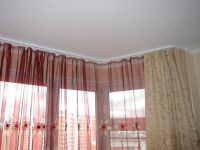
The suffering of people who want to decorate non-standard shaped balcony rooms with curtains has ended. Despite its plasticity, such a cornice does not crack and can withstand loads very well. You set the length of the product yourself by cutting the workpiece to the desired size and then installing decorative plugs. By the way, a flexible ceiling plastic curtain rod is suitable not only for installation on a bay window, it serves well in attic rooms, for separating zones in rooms that have a curved shape.
|
|

|

|

|
|

|

|

|