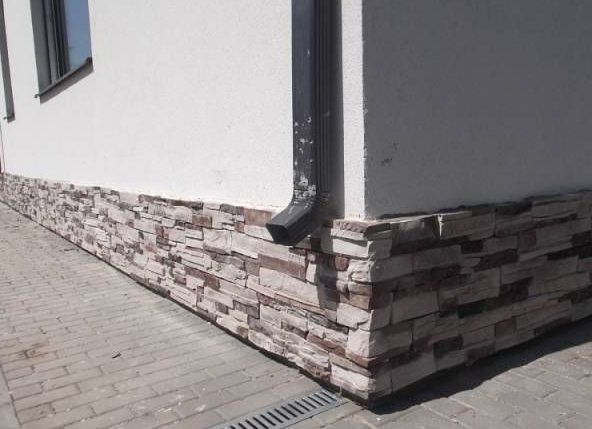
The appearance of the new house will not be completely finished if its foundation is not decorated, because the concrete wall does not decorate the building. Therefore, to give an aesthetic look of the entire extension, the foundation of the house is ennobled, applying for this a stone decoration gaining more and more popularity. In addition, such a decoration will protect the entire structure from various mechanical damage and adverse effects of weather conditions.
The lining of the foundation of the house should be strong, frost -resistant and not to be afraid of moisture. The decoration technology is selected depending on the presence of the foundation wall, as well as on the type of finishing material.
Types of finishing the foundation of the house under stone
In special demand, basement panels for stone are used to finish the foundation of the house. Firstly, such panels can withstand significant loads. Secondly, they are durable and the building, the base of which is decorated with panels under the stone, will look attractive and neat for many years. The material for basement panels is completely inert to various chemicals and reagents, frost -resistant and fireproof. A variety of color shades and the textured surface allow you to decorate the building in a variety of styles: from modernity to traditional classics.
The universal type of finish of the foundation of the house is siding that simulates natural stone. This material is easy to install in comparison with other types of building. Due to the fact that in the manufacture of siding, special substances are added, this material is able to withstand significant loads, does not burn out under the rays of the sun, and is resistant to external exposure. Even after many years, the decorative decoration of the foundation under the stone siding retains an excellent appearance.
An artificial analogue that imitates real material is also an excellent type of decoration of the foundation of the house under stone. The basis of artificial stone is a mixture of concrete with various additives: ceramic chips, pumice, perlite, as well as various dyes, which determine the color of the stone.
Externally, it is impossible to distinguish such a decoration from natural stone, but such a design is much cheaper than natural material. Compared to a real stone, the artificial weight has less weight, and therefore it is mounted much easier and faster. The building, the foundation of which is decorated with artificial stone, looks very impressive.

|

|

|

|

|

|

|

|

|