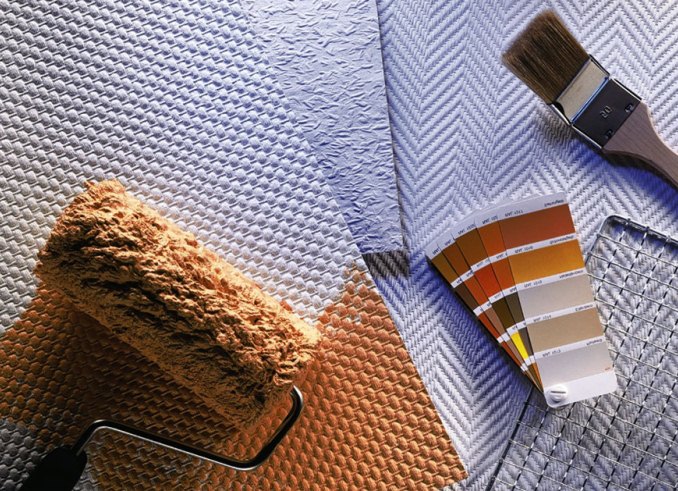
Having appeared at the beginning of the twentieth century, glass wallpaper immediately fell in love with designers, and today this type of decorative covering of walls and ceilings is becoming increasingly popular. Fiberglass wallpaper is a kind of fabric made of smooth and elastic fiberglass. During the manufacturing process, fiberglass fabric is impregnated with a special composition based on modified starch. When gluing glass wallpaper to a surface, this impregnation is mixed with glue and paint, ensuring a very reliable fastening of the canvas to the wall or ceiling. Therefore, glass wallpaper has such excellent technical characteristics:
- The maximum service life of glass wallpaper is up to 30 years.
- Fiberglass surfaces can be renewed (painted) up to 20 times.
- The roll has a standard size of 1m x 25m.
- The average density of glass wallpaper is from 110 to 220 g/sq.m. m.
- Fiberglass wallpaper has unique fire-fighting properties and good vapor permeability.
- Does not accumulate static electricity.
- They have high strength and excellent reinforcing properties.
- They are absolutely environmentally safe, as they are made only from natural materials: quartz sand, dolomite, soda and lime.
What do glass wallpapers look like?
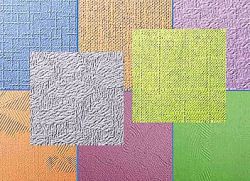
Before we find out which glass wallpaper is better, let’s find out what they look like. The simplest version of double-layer fiberglass wallpaper is a coating with a textured geometric pattern: herringbone, checkerboard, matting, diamond and others. A more complex and convex pattern of glass wallpaper is obtained if 12 or more threads are used simultaneously. An even more voluminous and more refined pattern can be obtained by applying compressed fiber to already finished fiberglass. Today, some manufacturers, at the request of the customer, can create unique design options for glass wallpaper, for example, with a corporate logo or symbols, a family coat of arms or emblem, etc.
Application of glass wallpaper
Thanks to these unique characteristics, glass wallpaper is used to decorate walls and ceilings in homes and hotels, offices and schools, hospitals and many other premises. Compared, for example, with liquid glass wallpaper, it can be washed and disinfected by any means, even rubbed with a brush, and it will not lose its attractiveness. However, remember that if you intend to stick such a coating, for example, in the kitchen, where the walls will need to be washed frequently, then to paint it you need to choose durable and high-quality paint.
Such wallpaper is difficult to damage or scratch, which is especially important if the family has children or pets. Thanks to its excellent strength properties, fiberglass wallpaper protects walls and ceilings from cracks and various other defects. Neither mold nor mildew will ever grow under such wallpaper.
Modern wallpaper manufacturers produce special glass wallpaper for walls in bathrooms and showers, where this coating completely replaces traditional tiles. Due to its special structure, reminiscent of woven fabric, such wallpapers contribute to the creation of an improved microclimate without interfering with the circulation of water vapor in the air, and also do not deform in a damp room.
Since glass wallpaper is not afraid of fire, does not melt at high temperatures and does not emit any substances harmful or toxic to humans under such conditions, they have a huge advantage compared, for example, with plastic panels.
Since glass itself is a dielectric, glass wallpaper does not accumulate an electrostatic charge, and therefore does not attract any dust, which is very important and valuable for families with allergies.
As you can see, there are many advantages to decorating indoor walls with glass wallpaper, so the choice of the best ones is yours.