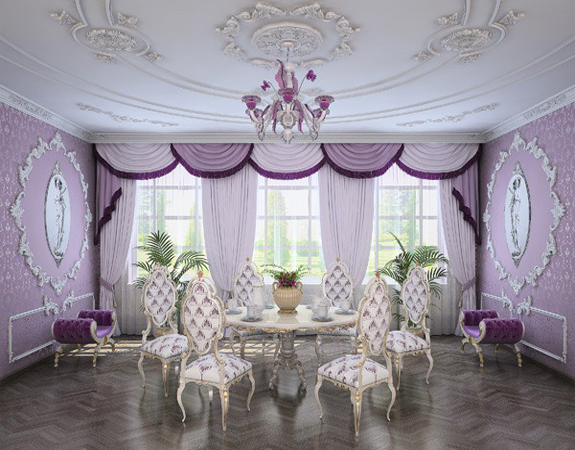
Decorating the interior and exterior with stucco is a tradition that has come to us from ancient times. This experience goes back to ancient times, when the science and art of Ancient Greece and Ancient Rome flourished.
Stucco molding created on the walls in the apartment will give the room sophistication and sophistication. The openwork uniqueness of the stucco decoration will not leave any viewer indifferent. You can decorate the walls with pilasters, install cartouches, or make entire compositions.
Decorative stucco in the form of panels on the walls will make the room special and rich. You can also use gables and keystones – all of this is offered in a variety of designs on the building material market, and can also be made to order.
What types of stucco are used in wall decoration?
The first thing that comes to mind is moldings or cornices. Decorating walls of this type with stucco makes the room collected and clear in outline. These are classic decorative elements that have a straight and angular cross-section. They mainly decorate the perimeters of the ceiling, create various frames, and also use them to divide the room into zones.
The next representative of artistic stucco on the walls is friezes. These figures have a straight cross section and are usually used for installation around the perimeter of walls. They frame various kinds of panels and are used for horizontal or vertical planar division of a room.
Medallions are a molded type of wall decoration, usually round or oval in shape. The medallion can be used both in a single copy and in rhythmic repetition. This element can also be part of a complex part of the design of a horizontal surface.
When decorating walls with stucco, you can use half-columns or pilasters. A semi-column is a semicircular element that protrudes only half its diameter. A pilaster consists of a base and a trunk, as well as a capital of a simple rectangular shape or a complex one. Both of these elements are involved in the design of window and door openings. They help divide the room into zones.
If you want to make a panel on a stucco wall, then it can be flowers, animals, picturesque views of the city or embankment, and much more.
What are the advantages of using stucco in interior design?
The first is accuracy. Gypsum stucco has excellent casting properties and ductility. These qualities allow us to work out every detail with maximum precision even at the manufacturing stage, regardless of the depth and complexity of the design.
The second is exclusivity. In addition to the finished products presented in stores, you can order from an individual sketch exactly the decor that you expect to see in your home. And the manual production of all models implies the uniqueness of the pattern.
Third is the individuality of the design. For the most part, gypsum decorative products are produced for each individual project, and therefore have a certain style, color scheme, geometry – everything is done taking into account the wishes of the customer.
The fourth advantage is functionality. Stucco molding located on the ceiling can serve as an excellent frame for hidden lighting. And also elements of stucco structures perfectly camouflage building structures and communications.
And the fifth factor that speaks in favor of using stucco decoration is versatility. As already mentioned, with the help of stucco structures you can divide the room into zones. Stucco molding smooths out the transitions between different textures of a room’s decoration.

|

|

|

|

|

|

|

|

|