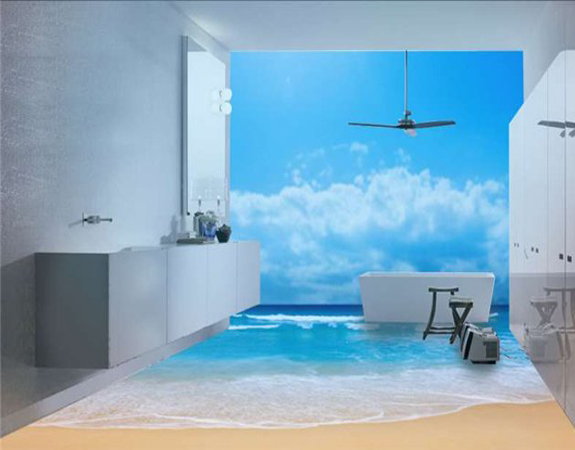
Self-leveling epoxy floors in an apartment offer a wide range of design solutions that can be used in any room. Of course, such floors are used in boutiques, shopping centers, and factories. But making your home an exclusive living space is a tempting prospect.
Self-leveling floors, in the production of which epoxy resin is used, meet all safety requirements, including fire and hygiene. In addition, they are easy to care for. They also have good resistance to chemical and mechanical damage. Therefore, a self-leveling epoxy floor is not only a high-quality, but also a stylish solution even for a garage.
Types of self-leveling epoxy floors
Epoxy two-component self-leveling flooring is otherwise called thin-layer epoxy coating. Why thin-layer? Its thickness reaches one millimeter. It is chemical-resistant and is more often used in rooms where aesthetics are given minimal importance. This could be, for example, a car wash.

|

|

|
Another type of coating is transparent self-leveling epoxy. It is more than one millimeter thick. It is used in rooms where alkalis and acids are involved in the work. The aesthetic performance of this floor is quite good; it copes well with decorative functions.

|

|

|
The third type of self-leveling floor is a quartz-filled epoxy coating. It is a two-component self-leveling floor. The thickness of such a coating is more than one millimeter. And each layer is accompanied by a powder of quartz sand. It is resistant to shock, chemicals and mechanical stress.

|

|

|
Any of these types of floors can be made decorative using a powder of polymer chips and flocks. These are particles of dried paint that are different in color and shape. Plus, if you wish, the floors, after undergoing special treatment, can become antistatic and anti-slip. And they are laid on a primed base.
Why is a self-leveling epoxy garage floor the ideal solution?
Typically, garage floors are concrete. And they very quickly become unusable – they begin to gather dust, and then chips appear, which bring with them other troubles. And in order not to run around with a bucket of cement every time, filling up many holes, it is worth choosing the optimal solution in the form of a self-leveling epoxy floor.

|

|

|
It is known that the primer base of the floor can penetrate five millimeters into the concrete covering, which significantly strengthens the floor. And the floor itself becomes hygienic and easy to clean.
3d floors – beauty and convenience
When we talk about a transparent self-leveling floor, beautiful floors come to mind, where fish “swim”, shells, plants, and tree leaves “live”. And all this is filled with transparent epoxy resin. Such wealth can be transferred to the tabletop, part of the furniture – it all depends on your imagination.

|

|

|
Epoxy self-leveling 3D floor is an opportunity to create your own microworld in your own home, where you will relax from the hustle and bustle of the outside world and everyday work. However, transparent self-leveling flooring has become more widespread, which is applied on site in the evening, and in the morning you can safely walk on it. Only the temperature of the base during operation should not be lower than ten degrees.

|

|

|
Unfortunately, self-leveling flooring in residential premises is still perceived as an exotic element. And to carry out work related to the installation of such floors, it is better to call specialists. After all, beauty is not created in one sitting. It is necessary to carry out preparatory work, make several main layers, and only after that the final, final decorative coating is done.