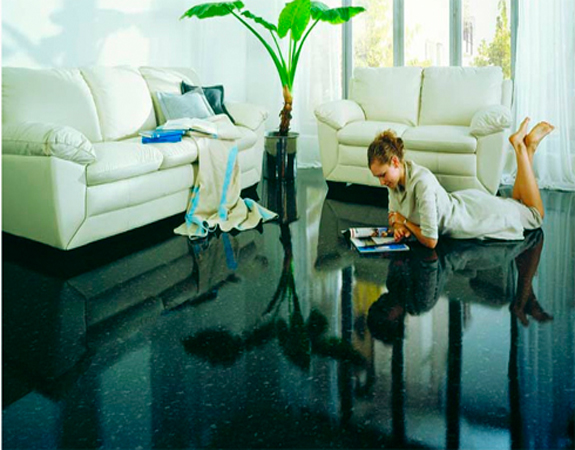
Self-leveling polymer floors are now one of the most modern developments in the production of floor coverings. This method of filling the floor is considered very promising and enjoys considerable popularity. Such floors have quite a lot of positive aspects: high wear resistance, aesthetic appearance, reliability, ease of maintenance, safety, impact resistance, hygiene and elasticity. There are many advantages; the presented type of floor meets the taste of the most pretentious users.
Such a floor is a synthetic coating, and when the composition changes, additional properties also change.
Types of self-leveling floors
Methyl methacrylate self-leveling floor is the fastest to put into operation; literally 3 hours after pouring it is ready for use. But it also requires highly qualified installation specialists. This type of polymer flooring has excellent strength and resists chemical and thermal aggression.
Polyurethane self-leveling flooring is elastic and rigid-elastic, just like the previous option, it requires excellent installation knowledge. One of the main qualities is the ability to close cracks at the base, resistant to shock and vibration, wear and household chemical compounds.
Epoxy self-leveling flooring is the toughest option of all presented. Less demanding for installation, resistant to ultraviolet radiation, chemical components, impact-resistant and wear-resistant.
Self-leveling polymer floors are used in a wide variety of ways; they look great both in houses and apartments, as well as in offices, shopping centers, warehouses, various industrial enterprises, exhibition halls, galleries, etc.
Let’s look at some examples
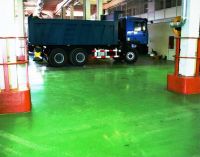
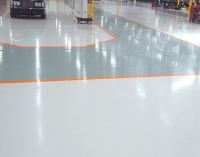
For a room like a garage, a polymer-based self-leveling floor is very suitable, and here’s why: it will look very beautiful and will protect the concrete base from chemical and mechanical damage. Polymer self-leveling floors are also widely used in covered parking lots and garages adjacent to hypermarkets. In places that are more heavily used, for example, a driveway, a self-leveling coating with the addition of sand is suitable to protect against deformation, and places intended for parking cars are filled with the addition of a paint coating.
|
|

|
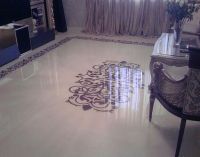
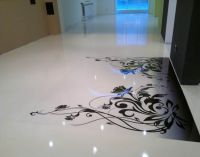
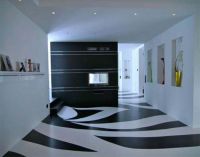
Possessing excellent performance properties, self-leveling polymer floors are perfectly suited for city apartments. These floors quite noticeably stand out from other floor coverings on offer, such as tiles, linoleum, parquet or laminate, in that they are practically not subject to wear and tear, are hygienic, will never develop fungus, and are easy to care for.
|
|
|
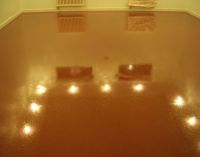
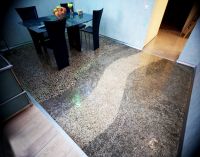
Self-leveling floors can be painted in the chosen color and decorated with any finish. In small apartments, such a floor will visually enlarge the space, since it has no joints or seams, and has a mirror effect.
|
|

|
An epoxy-based polymer self-leveling floor is more suitable for various laboratories, where it may be subject to chemical attack. This floor does not deform from exposure to alkalis, oils, acids or salts.
|

|
|
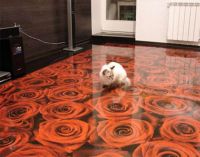
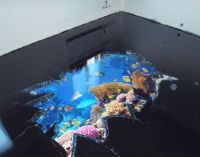
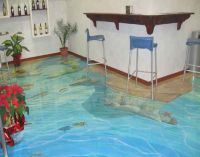
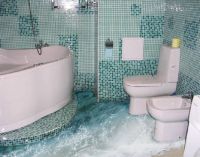
The peculiarities of self-leveling polymer 3D floors lie, first of all, in originality. This is a large-scale art object that presents a unique feeling of a three-dimensional image with a three-dimensional structure and color shades. Polymer self-leveling 3D floors are widely used in shopping centers, halls, apartments or offices.
|
|

|
Choose polymer floors according to your taste and you will receive incomparable satisfaction from contemplating it.