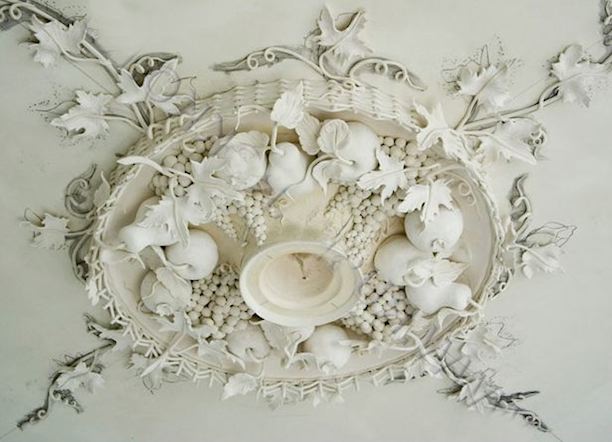
We all strive to live in a beautiful and cozy home. Today there are many decoration options that help decorate your home and make it truly original. And only true lovers of artistic design know how much gypsum stucco molding can transform any interior.
Stucco molding has been known and used for a very long time, since the times of ancient Greek culture. That’s why it pairs perfectly with period elements such as columns and arches. The past centuries have not destroyed, but rather developed and enriched this artistic art thanks to modern technologies. Today, anyone can decorate their home with plaster stucco.
Features of gypsum for stucco molding
As the name suggests, gypsum stucco is made from gypsum. It has many advantages, such as environmental friendliness, naturalness and durability. Gypsum does not emit harmful substances and is resistant to fungi. Among the disadvantages are only relatively heavy weight and fragility. Gypsum for artistic stucco is chosen grades G-7 and higher. This property of gypsum, such as expansion after drying, is very convenient for the production of stucco molding, because in this way small particles of gypsum can penetrate into all the holes of even the most complex shape for casting.
Types of gypsum stucco
In the interior, gypsum stucco can be found on walls and ceilings. The range of stucco decoration is quite wide and each of its varieties has many variations.
Gypsum stucco molding on the walls is represented by gypsum cornices, moldings, friezes and individual gypsum compositions. Cornices are used to decorate joints between walls and ceilings and to hide uneven seams between these planes. They can be very simple, smooth, or contain various ornaments and curls. Naturally, the more complex the gypsum composition, the more expensive such a cornice.
Gypsum moldings are some kind of decoration for the top of the wall in the form of a figured strip. They are somewhat similar to cornices, but they mainly play an artistic role and are combined with original plaster corner elements, creating a unique composition. Moldings can also decorate walls, framing individual sections of wallpaper or painted walls, giving the walls an expressive look.
Plaster friezes for walls are a decorative strip that frames the perimeter of the wall. Most often, gypsum friezes are used when covering a room with two different types of wallpaper, often contrasting. In this case, the frieze separates such wallpaper, creating an original room design.
For particularly sophisticated interiors, exclusive plaster compositions can be created that become the central point of the room. This is not a cheap pleasure, since hand-made plaster molding in this case is made to order and has no analogues.
Plaster stucco on the walls looks very elegant and makes any, even the most modest, interior chic. On the ceiling, stucco molding is used in the form of ceiling cornices and plaster rosettes.
Ceiling cornices are identical to wall cornices, but are mounted on ceilings.
Ceiling rosettes are a very popular decor. These are a variety of gypsum architectural elements that are placed around chandeliers or lamps. Various in shape, with abstract or floral patterns, rosettes truly transform a room and give it a special character.
Feel free to use gypsum stucco when decorating your home and appreciate its advantages. This element will not only decorate your walls and ceilings, but will always remain in fashion.

|

|

|

|

|

|

|

|

|