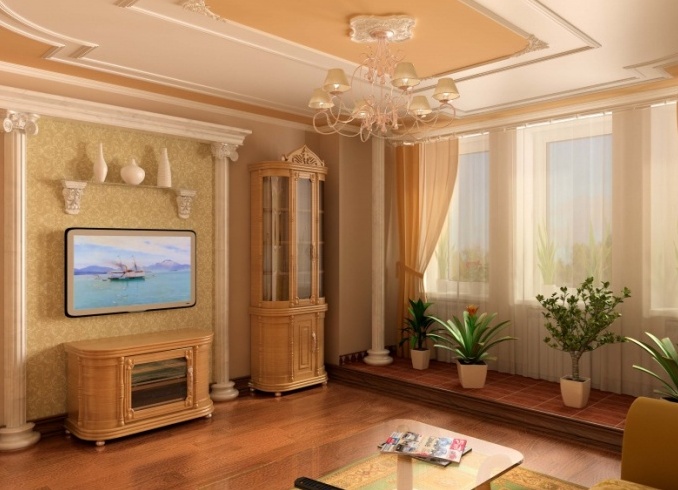
At the final stage of renovation, the question always arises about the harmonious unification of the surface of the wall and ceiling. After all, if you leave this joint without decoration, the repair will have an unfinished appearance. It is for these purposes that ceiling plinths are used.
Ceiling plinth (baguette, fillet) is available from various materials. But the most popular are products made from polyurethane. This is due to the undeniable advantages of polyurethane over other materials:
- polyurethane is more durable than wood or plaster;
- it does not absorb moisture and does not change properties under the influence of temperature changes;
- The polyurethane surface is easy to clean;
- polyurethane is easy to install;
- white polyurethane ceiling plinth can be painted in any color;
- polyurethane can be glued to surfaces of any material;
- it doesn’t crumble;
- To glue polyurethane skirting boards, you can use either glue on any base or a mixture of putty.
In addition, flexible ceiling polyurethane plinth can be glued to the ceiling of any complex shape, without fear that it will break.
Polyurethane skirting boards for the ceiling
Polyurethane skirting boards are available both smooth and with a variety of patterns. Externally, they are no different from stucco, but at the same time they have better functional characteristics. Therefore, you can choose a plinth for an interior decorated in any direction: from a laconic loft to a sophisticated empire style. At the same time, images on polyurethane skirting boards turn out to be very clear and embossed.
To decorate the joints of walls and ceilings adjacent at different angles, polyurethane skirting boards are made at an angle of 30.45 and 60 degrees. In addition, for the convenience of installing skirting boards in the corners of the room, there are special corner segments. Externally, their design fully corresponds to the images on the ceiling plinths.
Installation of polyurethane ceiling skirting boards
Polyurethane skirting boards can be mounted using any adhesive. But it must dry quickly, because standing for a long time with your hands raised to the ceiling is not the most pleasant experience. The most common materials for installing polyurethane skirting boards include liquid nails, Moment glue and any silicone sealants.
The most difficult thing when installing ceiling plinths is cutting them correctly to join them in the corner. But this problem is solved with the help of corner segments or special carpentry wort. Here you should remember one simple rule: when cutting skirting boards for an external corner, their upper parts are always longer than the lower ones. And for the inner corner, on the contrary, the upper parts are shorter than the lower ones. Before you start gluing the plinth, the surface of the wall and ceiling must be cleaned of dust and primed. After this, you can begin installation. The glue is applied to the surface of the baseboard either in drops or in wavy lines, and then pressed tightly against the junction of the wall and ceiling. You should always start gluing skirting boards from the corner of the room.
In addition, polyurethane ceiling plinth can be used as a basis for lighting. There are no additional difficulties during its installation. But in this case, the plinth is glued at a distance of 10-20 cm from the ceiling surface, and in order to do it evenly, you need to use a level. Also, the baseboards for lighting should not be very deep, so that they do not block the light. And after the plinth is glued, you can begin installing fluorescent lamps or LED strips. With this design of contour lighting of the room, the effect is no worse than when constructing a three-level ceiling, but much cheaper.

|

|

|

|

|

|

|

|

|