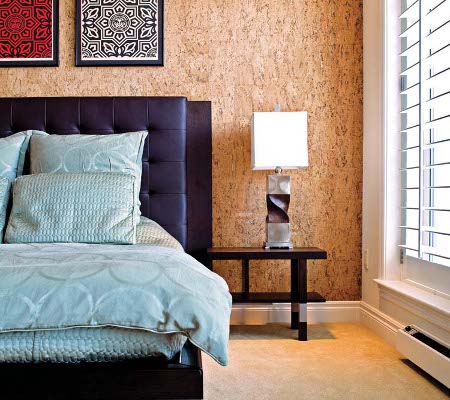
Cork has appeared on the building materials market for quite some time, but only in the last few years has it been actively used for finishing floors and walls. This material gained its popularity largely due to its environmental friendliness and spectacular appearance. Pasting cork onto walls is a creative process and designers manage to create entire panels and replace traditional wallpaper with them.
Cork covering on walls – advantages
Currently, this material is used for wall decoration in three main versions: tiles, rolls or wallpaper. The tiles are made according to the same principle as cork backing on the wall in the form of rolls. The slabs come in one- and two-layer types; the top layer is coated with varnish or wax.
The fact is that the cork itself is not afraid of high temperature or humidity, but all the binding materials and paint have to be protected. Such tiles most often have a thickness of approximately 2 mm. If this is a two-layer option, then the pressed base is covered with a special glue and natural or agglomeric veneer interspersed with different colors is attached on top. The standard dimensions of such slabs are 3x300x300 mm or 3x600x300 mm.
You can even use regular laminated flooring boards. Of course, their direct purpose is to finish the floor, but if desired, they can even be used for walls. Here you will have to resort to the help of professionals, since the installation of such boards requires some skills and special tools.
Cork covering the walls has a number of advantages:
- the material is natural, but its insulating properties are in no way inferior to those of the most advanced synthetic analogues;
- cork practically does not absorb moisture;
- a cork board on the wall is resistant to various chemicals, about the same as many polymers;
- This coating does not harbor mold or rot, and insects do not grow in it.
So, if you are looking for a truly reliable coating that should last at least several decades, feel free to give preference to cork. Modern technologies make it possible to produce tiles of a wide variety of shades and colors. So you can choose your option both for a chic country house in a classic style, and for a small apartment with a modern urban renovation.
Cork backing on the wall – main points during installation
Due to all of the above qualities, cork can be used in rooms with any level of humidity and temperature. If synthetic insulation such as mineral wool or polystyrene foam is highly flammable and does not always cope with its task, then with cork you can be sure of retaining heat and even in direct contact with fire it will not burn.
Installing cork coverings on walls is simple and can be mastered by a person who has never dealt with wall decoration before. You can purchase special glue and simply fix the tiles in the required order with simple screws. Another important point: if located close to a heat source, the plug can accumulate it and release it over time while the source is turned off.
Cutting the required dimensions is very easy and a regular construction knife is sufficient. If you decide to lay the cork board on the wall in one go, you can do it without fear. There are no restrictions here, as in the case of ceramic tiles: nothing will start to creep down. When working, it is advisable to start moving from the center of the wall and gradually move to the periphery. We retreat about 1-2 cm from the floor so that later we can install the skirting boards. Install tiles correctly without using crosses.

|

|

|

|

|

|

|

|

|