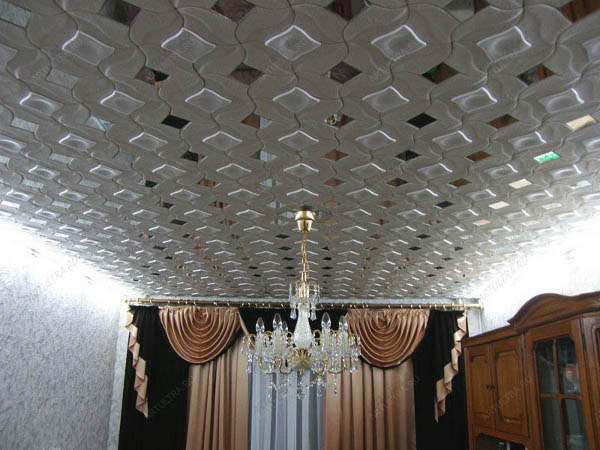
For those who are planning to finish the ceiling themselves, it makes sense to try the so-called seamless ceiling tiles. This type of finishing materials is good because it is very easy to work with and even complete amateurs in the repair business will be able to decorate the ceiling quite well.
Which ceiling tile is better?
We start by selecting the type of seamless tile. Today there are several of them.
- The so-called pressed tiles are made from foamed polystyrene using hot stamping technology. During processing, sheets of this material are compacted and tiles of approximately 7 mm are obtained. The dimensions of the finished product are standard 50×50 cm. This approach allows you to easily calculate the required number of packages and simplifies the work.
- The injection type is more durable, since its thickness is about 14 cm. The pattern is clearer due to its greater depth. There is a slightly different principle here: the granules of the material are sintered together and then they are no longer destroyed. When choosing, you should pay attention to this type, since companies offer absolutely snow-white slabs, which do not even need to be painted (unless, of course, you were planning a white ceiling).
- The third type is called extruded. In this case, the thickness of the finished product is only 3 mm, but this option is much stronger and more durable than the previous two. Among the companies’ products you will find a wide variety of designs and textures: imitation wood carving, gypsum stucco or textiles, there are options in white and with colored film.
To answer the question of which ceiling tile is better, you should start from your goals. The most budget option is pressed. This type can be safely painted with both water-based and acrylic paints. If the emphasis is on the originality of the finish, you should give preference to the last two types.
As for manufacturers, here you will have to talk quite a lot with consultants in a hardware store. For example, Chinese manufacturers usually produce much thinner slabs than Europeans. Products from Germany usually have higher moisture resistance and a wider range of sizes. Ceiling tiles from Format are popular. Manufacturers offer all three types and an incredibly wide range of designs. In addition to Format ceiling tiles, products from the Amstrong series made from so-called stone mineral wool are in demand.
Seamless ceiling tiles: advantages and disadvantages
So, you have decided to try polystyrene foam ceiling tiles. Then you should familiarize yourself in advance with the weaknesses of this material and compare them with the obvious advantages.
Among these advantages, we note the following:
- the first and obvious one is low cost;
- ease of installation can also significantly save you money, since you can do the work yourself and do without the services of a specialist;
- ceiling unevenness is completely hidden under the tiles, small cracks and more significant defects do not have to be previously repaired and leveled;
- tiles do not “eat up” a lot of height, like suspended or tensioned structures, which is perfect for rooms with low ceilings;
- seamless ceiling tiles are made from polystyrene foam, which is known to everyone for its thermal insulation properties;
- Caring for the ceiling is quite simple.
Of course, tiles will not be able to protect you from flooding your neighbors above. In addition, you will have to use exclusively detergents for dishes or washing clothes, as the rest will simply damage the surface. This means that difficult to remove stains such as rust or water stains (which are often found in apartments on the top floor) will have to be painted over in several layers. Otherwise, just wipe the ceiling with a soft cloth or vacuum it.

|

|

|

|

|

|

|

|

|