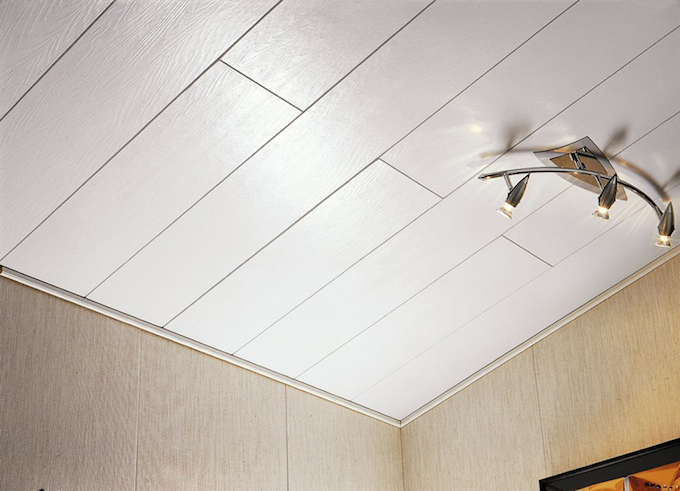
The choice of materials during renovation of a room largely determines the beauty and quality of the final result. One of the easiest and most financially profitable options for finishing ceilings today is lining them with decorative panels made of polyvinyl chloride, which are abbreviated as PVC panels.
What is the secret of the popularity of these finishing materials? Let’s look at their positive and negative sides.
Advantages of PVC ceiling panels
Covering the ceiling with PVC panels does not require special construction qualifications, because it is quite simple. If you study all the nuances, anyone can install panels on the ceiling.
In addition, today such building materials are presented in stores in a huge assortment. PVC ceiling panels may vary in size, color and texture (matte or glossy). They are able to imitate marble, wood, and other popular finishing materials. At the same time, the cost of PVC panels is more than affordable.
Another advantage of PVC ceiling panels is their amazing moisture-resistant characteristics and ease of maintenance. Microorganisms, mold and mildew do not multiply on their surface. You also don’t have to worry about the influence of chemical care products. Thanks to this, PVC panels are widely used to decorate the ceiling in the bathroom.
The ceiling structure made of PVC panels allows you to successfully hide all defects in the ceiling; under them it is easy to hide all kinds of engineering structures and wires.
Disadvantages of PVC ceiling panels
Unlike wall panels, PVC ceiling panels are very fragile, so they must be handled with particular care during transportation, installation and operation.
It must be remembered that even slight pressure on such building materials with your hand or some tool can leave a dent and irrevocably ruin the appearance of the panel.
Direct sunlight is contraindicated for PVC panels, as it leads to fading and deformation over time.
Like all plastic products, such panels are susceptible to fire, although they can withstand temperatures up to 350°C. Moreover, when PVC panels catch fire, they emit a very poisonous gas for humans. Based on this, it is not recommended to cover surfaces that are in contact with heating sources with panels.
Perhaps the last drawback can be called a biased attitude towards the ceiling finished with plastic. Indeed, cheap types of plastic PVC panels do not look particularly presentable. But with more expensive samples you can easily decorate any room.
PVC film for suspended ceilings
For rooms with suspended ceilings, they often use not panels, but other modern materials. PVC sheets for suspended ceilings are made from a film of a special composition, which is first heated, and then stretched and fixed to the ceiling. After shrinking and cooling, such ceilings look perfectly smooth and incredibly beautiful. PVC film for suspended ceilings is incredibly flexible, so its size is initially much smaller than the size of the ceiling. It, like panels, can have different textures, colors and other parameters. Anyone who decides to use such material in construction will be able to choose a sample to suit their taste.
PVC ceiling tiles
This ceiling finishing option consists of square or rectangular elements made of polyvinyl chloride, which are attached to the ceiling with special glue. PVC ceiling tiles are incredibly lightweight and very easy to install, maintain and use.

|

|

|

|

|

|

|

|

|