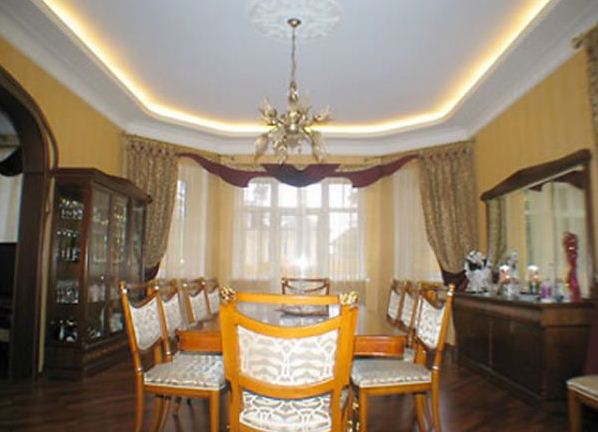
Typically, a ceiling cornice has the form of a flat rail, which is attached directly to the ceiling: regular, suspended or tensioned. A cornice for a stretch ceiling simultaneously performs two functions: both practical and aesthetic. Curtains or tulle are often hung on such cornices, and additional lighting can be installed on them. And, of course, a beautiful ceiling cornice for suspended ceilings serves as a decoration for any interior.
Types of cornices for suspended ceilings
Depending on the method of fastening, ceiling cornices for suspended ceilings come in two types:
- curtain rods;
- cornices for lighting.
In addition, cornices can be visible or invisible. They can be made of aluminum, steel, plastic or wood. Let’s take a closer look at these types of cornices.
Curtain rods for ceilings
Everyone knows that the stretch ceiling fabric is located below the floor slab. This means that the installation of the cornice will need to be given more attention, even at the stage of installation of the stretch ceiling itself, and not during the attachment of the cornice.
Before you start stretching the ceiling, you should install a special wooden block at the place where the cornice will be attached, to which the cornice will subsequently be attached. The length of this block should be equal to the length of the cornice, and its thickness should be slightly less than the distance from the ceiling to the stretched ceiling. That is, this block must be hidden behind the suspended ceiling.
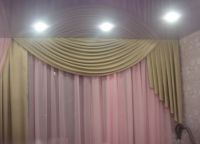
On the stretched ceiling sheet, you must carefully mark the places intended for attaching the cornice. To prevent the film from tearing in the future, special rings made of PVC film or thin plastic are glued to the places where the cornice is attached. Now all that remains is to carefully burn small holes in the marked places and attach the cornice directly on top of the stretch ceiling. This option for visible fastening of a ceiling cornice is the simplest to implement and is used quite often.
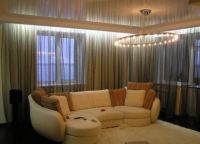
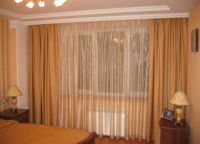
Another installation option is an invisible ceiling curtain rod. At the same time, the cornice itself is hidden behind the stretch ceiling. Falling curtains look especially beautiful next to a glossy stretch ceiling. This type of suspended ceiling cornice is usually attached to the main ceiling. The profile for a suspended ceiling must be installed on a wooden block with a length equal to the length of the wall. This creates the effect of a curtain flowing from the ceiling. And although the installation of such an invisible cornice is a little more complicated than the previous one, from a design standpoint this option is more attractive.
|
|
|
Cornices for LED ceiling lighting
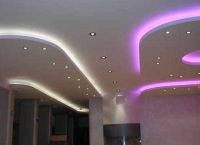
Today, eaves ceiling lighting is becoming increasingly popular. For this purpose, special cornices and LED strip are used, the lamps of which are evenly distributed along the perimeter of the cornice. They can be made of plastic, MDF or even wood. In this case, the room is illuminated by light reflected from the ceiling, which seems to float in the air. At the same time, the space of the room visually becomes wider thanks to such lighting.
Ceiling cornices for lighting can be installed both around the perimeter of the entire ceiling and in special niches for lighting. Because of such cornices, light can be directed both to the ceiling and down.
Cornices for decorating the ceiling and designing LED lighting can be smooth or decorated with a variety of patterns. If you decide to use colored ceiling lighting, then smooth, discreet cornices are more suitable for it.
The advantages of polyurethane curtain rods include the fact that they are fireproof. In addition, they can be easily bent if the room has rounded corners or you are decorating the lighting for a round ceiling.

|

|
|