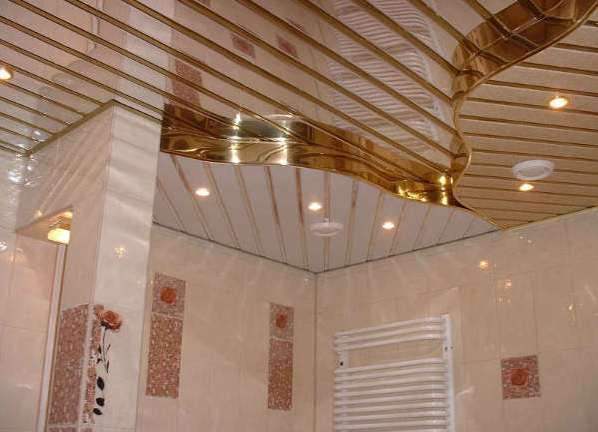
Until recently, we could update the ceiling in a room using whitewashing, painting with water-based paint, or wallpapering. Today, many other options for ceiling decoration have appeared: suspended and suspended, glass and mirror, stained glass, plasterboard and plastic.
Advantages and disadvantages of plastic ceiling panels
Compared to other types of ceiling finishing, plastic ceiling panels made from polyvinyl chloride have many advantages:
- strength;
- durability;
- good sound insulation;
- moisture resistance;
- resistance to ultraviolet rays;
- non-flammability;
- environmental cleanliness.
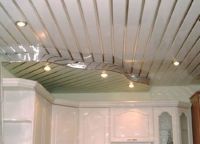
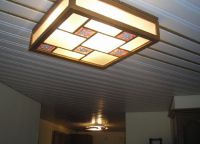
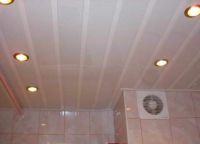
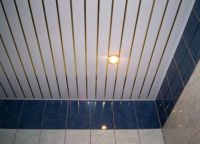
Thanks to these properties, plastic panels are successfully used in the decoration of ceilings in both public and indoor areas. Plastic ceilings allow you to replace conventional electrical wiring with special circuits for installing halogen or LED spotlights.
|
|
|
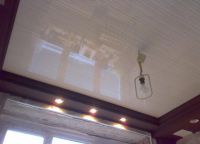
Plastic panels perfectly hide small unevenness in the ceiling. The panels can be used to successfully disguise water supply pipes, ventilation pipes and other communications. By choosing light PVC panels, you can visually increase the height of the ceilings in a small room. Installation of lightweight plastic ceiling panels is quite simple: even a novice master can handle it.
Plastic ceiling panels have the best price-quality ratio.
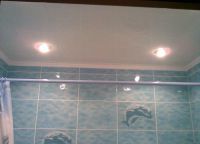
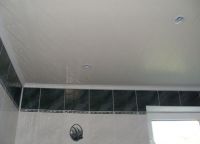
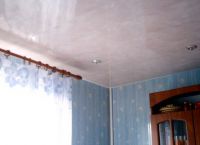
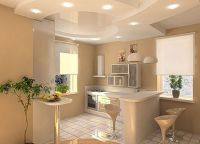
Plastic panels, due to their excellent water-resistant properties, are successfully used for decorating ceilings in toilets and bathrooms, kitchens and hallways.
|
|
|
|
|
|
This coating can withstand significant changes in temperature and humidity without changing its appearance or technical characteristics. Plastic panels are often used to cover ceilings on balconies or loggias. And exclusive ceiling panels from global manufacturers can serve as decoration in the living room, bedroom or office.
The disadvantages of plastic panels include their fragility: even slight pressure on them can leave dents. Therefore, when installing such ceiling panels, you should be very careful and careful.
There are many options for plastic panels. They vary in length and width, texture and color, and can be an imitation of marble, wood or other finishing materials. They produce matte and glossy ceiling panels, coated with a special varnish layer. There are plastic ceiling panels that are colored and even patterned.
Plastic panels for suspended ceilings can have a continuous appearance with a perfectly flat surface that can be painted or even wallpapered. Other types of panels have a distinctly stacked appearance, imitating, for example, wooden panels.
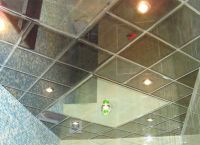
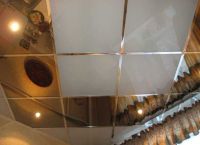
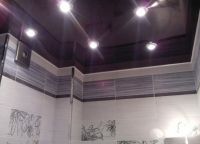
Fans of mirror surfaces in the interior should pay attention to mirrored plastic ceiling panels.
|
|
|
This fairly cheap and simple finishing option is based on covering the panels with a special reflective film. These flexible strips or squares are attached to the ceiling using cement, glue, and sometimes screws. The surface of the ceiling under such panels must be well leveled, since the mirror surface, if uneven, will give a distorted image. Due to the good flexibility of mirror plastic panels, they can be successfully used on various curved surfaces. However, such material has fire hazardous properties. Therefore, it is not recommended for use in spot lighting of rooms.
Such mirrored ceilings are more suitable for large rooms: exhibition or gym halls, shopping centers or even swimming pools. Suspended ceiling panels can be perfectly combined with other suspension systems, such as plasterboard or glass.