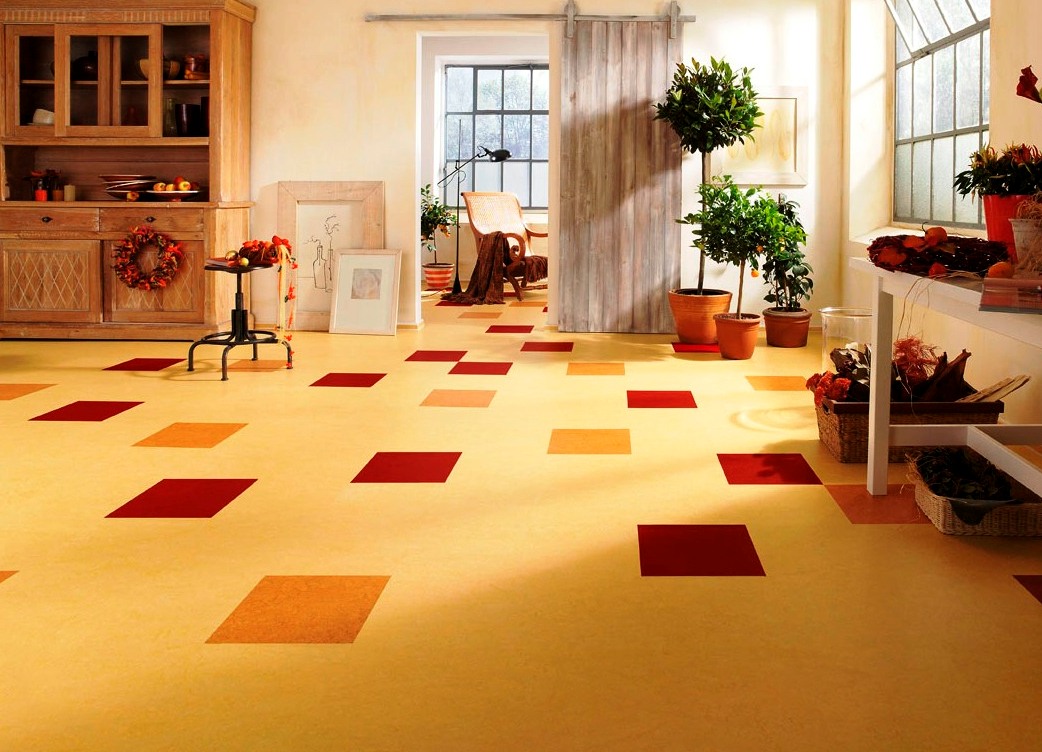
Once faced with repairs, a person begins to be interested in various issues that did not even bother him before. Which wallpaper or wall paint to choose? What kind of lighting should I install? How to decorate windows? Another popular question that worries almost every homeowner is the question of choosing flooring. The choice varies between laminate and linoleum, as these are the most popular options today. So, what should you choose? Let’s try to figure it out.
What is the difference between laminate and linoleum?
Before you start analyzing the properties of each material, you need to decide what they are. So, laminate is a coating consisting of layers. At the bottom there is a layer of moisture-resistant paper above which there is a layer of hard fiberboard. In the upper part there is a moisture-resistant film covered with printing paper with a pattern imitating laid parquet boards made of valuable wood (maple, cherry, beech). The design is completed by a layer of acrylate/melamine resin, which provides abrasion resistance, color fastness and resistance to chemicals. Laying the laminate is carried out by joining special locks.
Unlike laminate, linoleum is made from polymers and special additives that provide resistance to mechanical stress. Linoleum, like laminate, consists of many layers, but their composition and purpose are radically different. Here, instead of fiberboard, foamed PVC is used, and the protective function is performed by extra-strong vinyl. Linoleum may have a fibrous base that increases its thickness and hides uneven floors. Laying of the canvas is carried out using a binding material similar in composition or special glue.
What to choose – linoleum or laminate?
Having understood the definitions of these two floor coverings, we can begin to discuss the advantages and disadvantages of each of them. The following points are important here:
- Soundproofing. Laminate itself does little to dampen noise. Of course, the level of sound insulation will be influenced by the quality of the substrate, but it will not save you from the clicking of heels or the sounds of falling objects. Linoleum, on the other hand, is a more plastic coating, so it partially absorbs shock loads. Thick linoleum with a foam or felt base has high soundproofing properties.
- Insulation of the apartment. If we compare the thermal conductivity of polyurethane and wood, then linoleum will lose. But there is one “but” here. The thickness of laminate intended for homes starts from 0.6 cm, while the same thickness is the maximum for standard linoleum. It should also be taken into account that the thickness of the underlay influences the properties of the floor. Even a few millimeters of inexpensive isolon under the laminate will provide a degree of thermal insulation no worse than that of thick linoleum.
- Ecology. Connoisseurs of everything natural ask themselves the only question – what is more environmentally friendly, laminate or linoleum? Many people mistakenly believe that laminate is completely environmentally friendly, justifying this by the fact that its basis is fibreboard. But what about the other layers that give it a decorative look? After all, they are completely synthetic.
- Moisture resistance. Laminate manufacturers openly state that their products can warp and swell when exposed to humidity. This does not apply to linoleum. Not only will it heroically endure cleaning the floor, but it will also prevent the neighbors below from being flooded.
There is no point in talking about the naturalness of linoleum at all, since it is made from polyvinyl chloride.  Thus, both materials have synthetic inclusions and therefore cannot be called environmentally friendly.
Conclusions
As you can see, laminate and linoleum have a number of advantages and disadvantages. Ideally, it is better to select flooring individually for each room. So, in rooms with high traffic (kitchen, hallway) it is better to put linoleum, and in all other rooms – laminate.