
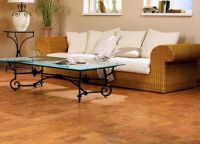
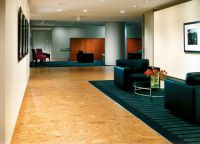
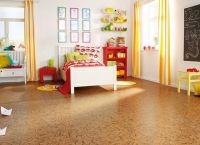
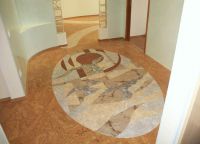
Do you want your floor to be natural, stylish and healthy? Then you should choose cork flooring. It has heat and sound insulating properties and retains elasticity and softness throughout its operation. In addition, cork, due to the presence of tannins, is capable of destroying microbes, thus disinfecting the room. These and many other beneficial properties have made cork flooring ideal for the kitchen and children’s room.
Brief description
A three-layer cork board has the following component composition: decorative cork veneer, crushed oak bark, polyurethane varnish and a layer of MDF. Dried oak bark granules are mixed with glue and pressed, resulting in a closed cellular structure. This substance is cut into plates on the surface of which cork veneer is applied. The resulting sheets are sanded and coated twice with polyurethane varnish.
Installing cork flooring
A wooden floor should be covered with sheets of plywood or fiberboard, and a concrete floor should be filled and leveled with a special mixture. Once the rough surface is smooth and clean, begin laying the sheets. Fixation can occur with or without contact adhesive (“floating floor”). Please note that you can walk on the floor immediately after installation, but it is better to move furniture in after 24 hours.
Caring for cork flooring
To wash the floor, you need to use gentle detergents that do not include abrasive particles and solvents. You can also choose special cork floor care products that will not only remove dirt, but also add shine to the varnish coating. If the coating begins to wear out, then you need to use a special restoring polyurethane varnish.

|
|
|
|
|
|
|

|

|

