Content:
-
What does a modular sofa mean: the essence of the design without marketing
-
When is a modular sofa really comfortable, and when is it a waste of money?
-
Types of modular sofas: how not to get confused in the options
-
How to understand which modular sofa is right for you
-
What to look for when choosing: non-obvious details
-
Common mistakes when buying a modular sofa
-
Comparison: modular sofa vs classic
-
Bottom line: how not to make a mistake when choosing a modular sofa

What does a modular sofa mean: the essence of the design without marketing
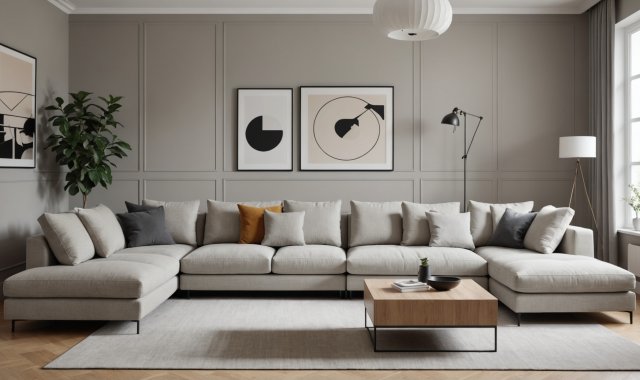
A modular sofa is not a “special style” or just a design feature, but a specific type of construction. Its basis is a set of individual elements (modules) that can be combined with each other. Unlike a one-piece sofa, which comes ready-made and has a fixed shape, modular furniture allows you to assemble a configuration for the room and task.
It is important to understand: modularity is not always about freedom without restrictions. Each sofa consists of specific elements included in one series. They are designed for specific connections, sizes and shapes. It is most often impossible to mix modules from different models or companies.
Basic elements that make up a modular sofa:
- straight sections – main seating unit
- corner modules – form a rotation of the structure
- island elements – used in the center of the room
- poufs – mobile parts without a back
- consoles and shelves – functional inserts between sections
The main difference from the classic corner sofa is not the shape, but the assembly principle. A corner sofa may look similar, but its design is most often one-piece or conditionally collapsible, without the ability to change the configuration.
There are different ways to connect modules:
- rigid fixation – elements are connected by fastenings as a single structure
- conditionally mobile assembly – hidden hooks allow you to separate parts
- free layout – modules simply stand side by side without fixation
The latter option looks attractive in the catalog, but in practice it raises questions: elements can move apart, especially on a smooth floor. This is one example where modularity becomes a limitation rather than an advantage.
There are other nuances. For example, different series within the same company may be incompatible. Having bought a sofa today, you will not always be able to buy a module of the same color or shape in a year. This is an important point that is rarely voiced in articles and when selling.
The result is simple: a modular sofa is a system of individual elements with the possibility of configuration, but within the framework of a predetermined design. This is a tool, not a universal solution.
When is a modular sofa really comfortable, and when is it a waste of money?
Modular furniture is not revealed in every interior. Its advantages are noticeable only in specific use cases.
It is really convenient if:
- you often make rearrangements and like to change the interior
- non-standard room layout (niches, bay windows, complex geometry)
- you are moving and want to adapt the sofa to the new space
- you need to zone the room, for example, divide the living room and kitchen
In these cases, the modular design allows you to change the shape of the sofa without purchasing new furniture. For example, today it is a corner option, but after moving it is a straight one.
But there are situations where modularity is redundant:
- the sofa is always in the same place
- standard space, no complicated corners
- no need to change configuration
A common mistake is expecting the configuration to change regularly. In practice, most users rearrange the modules once or twice after purchase, and then the sofa remains in the same form for years.
A few everyday examples:
- small apartment: modularity can help you fit into the space, but sometimes it’s easier to go with a compact straight sofa
- studio: island and corner modules help to zone the room
- large living room: a modular sofa allows you to create a flexible seating area with poufs and additional seats
If you don’t plan on changing the shape and aren’t limited by a complex layout, a classic sofa is often cheaper, simpler and more durable.
Types of modular sofas: how not to get confused in the options
The range of modular upholstered furniture looks varied, but it can be systematized. This helps you not to get lost in the catalog and understand which solutions are truly different.
Based on the shape of the structure, they are distinguished:
- straight lines – a baseline of several modules
- corner – with one turn
- U-shaped – for large rooms
- island – placed in the center of the room
By connection type:
- stationary – modules are fixed and rarely disconnected
- mobile – you can change the configuration without tools
By symmetry:
- symmetrical – identical elements on both sides
- asymmetrical – more flexible, but more difficult to select
A separate category is models with a berth. Here it is important to consider not only the presence of a mechanism, but also its type. Some modules fold out, others don’t, and this affects the final functionality.
A non-obvious point: the same names do not guarantee the same flexibility. Two sofas may be called “modular”, but one allows dozens of assembly options, while the other allows only 2-3 fixed combinations.
Therefore, when choosing, it is important to look not at the description, but at the actual diagrams of the modules and their connection options.
How to understand which modular sofa is right for you
The choice should start not with color or style, but with the use case. The same sofa can be comfortable for a family and uncomfortable for one person – and vice versa.
Ask yourself a few key questions:
- how many people use the sofa daily
- Do you need a full-fledged sleeping place?
- will you actually change the configuration
- Is there a need for additional storage elements?
If the sofa is used as a bed, the following are important:
- smooth surface without joints
- high-quality transformation mechanism
- sufficient sleeping space (at least 140 cm wide)
The size of the room is another critical factor. The mistake is to focus only on the dimensions of the sofa from the catalog. Important things to consider:
- passages (at least 60–70 cm)
- distance to walls and other furniture
- possibility of decomposition
Ergonomics directly affects comfort:
- seat depth – from 50 to 70 cm
- planting height – about 40–45 cm
- hardness – depends on preference, but models that are too soft lose their shape faster
Practical example. A family of three chooses a sofa for the living room. They care about seating, the ability to accommodate guests and sometimes use the sofa as a bed. In this case, a corner modular design with one folding module and additional poufs is suitable.
One person in a small apartment often benefits from a compact sofa with a clear sleep function, without complex modularity.
The “take the most flexible option” approach does not always work. Sometimes it is better to choose a simple but thoughtful design.
What to look for when choosing: non-obvious details
Appearance is only part of the solution. The main problems appear after several months of operation, when weak points in the structure become apparent.
The frame is the basis of the sofa. It’s better to choose:
- solid wood or metal
- quality plywood
Chipboard is often used, but is inferior in durability.
Module fastenings are a critical element. If they are weak, the sofa loses its shape and the modules begin to diverge. This is especially noticeable in models without rigid fixation.
Fillers determine comfort and service life:
- polyurethane foam – balance of price and durability
- spring blocks – keep their shape better
- soft fillers are comfortable, but sag faster
The upholstery must correspond to actual use. For a home with children or animals, it is better to choose wear-resistant fabrics with protective treatments. Light colors look impressive, but require regular maintenance.
The joints between modules are one of the most vulnerable elements. After a year of use, they may become more noticeable, especially if the sofa is used as a sleeping place.
Additional elements:
- storage drawers – useful in small spaces
- armrests – add comfort, but take up space
- built-in tables and shelves are convenient, but limit rearrangement options
Each element affects functionality. Sometimes minimalism turns out to be more practical than a complex design.
Common mistakes when buying a modular sofa
Most problems are not related to the quality of the furniture, but to incorrect expectations.
- purchase based on the picture without checking – in reality the sofa may differ in hardness and size
- ignoring the size of the room – the sofa looks smaller in the catalog than in the room
- overestimation of modularity – configuration rarely changes
- the choice is based only on price – cheap models often have weak fastenings
- incompatibility of modules – purchasing additional elements later may be difficult or impossible
A separate point is the agreement for the processing of personal data when ordering online. When purchasing through online stores, you should pay attention to the terms of delivery, assembly and return. This affects no less than the characteristics of the product.
Comparison: modular sofa vs classic
A modular sofa benefits from flexibility. It allows you to adapt the space and change the shape of the structure. This is convenient in non-standard premises and when moving.
A classic sofa is more stable. It has fewer weak points, easier assembly and often lower price. It is better suited for those who do not plan to change.
In terms of durability, one-piece structures often benefit from fewer joints. In terms of cost of ownership, modular sofas can be more expensive, especially if additional elements are purchased.
Bottom line: how not to make a mistake when choosing a modular sofa
A modular sofa is not just a modern trend, but a tool for specific tasks. Its key feature is adaptability, but it only makes sense when used.
The main guideline is your lifestyle and use case. If you don’t change the configuration, modularity loses some of its benefits. Choose not shape and color, but functionality, design and real operating conditions.