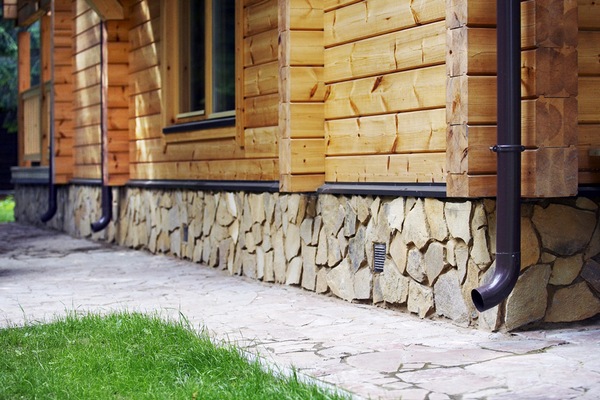
The base of the house is the lower part of the external walls, its cladding acts as protecting the entire facade from mechanical damage, pollution, the effects of atmospheric humidity and other adverse factors.
Options than to sheathe the basement of the house, just a mass – from plastic panels to natural stone. All of them have their characteristics, advantages and disadvantages. We offer to consider several options that are most common and are popular in our time.
Facing with natural materials
For cladding the base of the house by natural stone, one of the options is used – granite, marble, sandstone, lemesite, dolomite, shungite, quartzite, slate or shell -to -hem.
For lining the base of the house with wild stones (cobblestones), stones with a flat surface, 2-3 cm thick. If their size is too large, you can work with a sledgehammer. The resulting flat stones are simply laying, they are strong and reliable, and the appearance of the house is simply amazing. Wooden houses look especially rich with such a cladding of the basement.
The undeniable advantages of such decoration are durability, strength, attractive appearance. However, there are also disadvantages: high cost, hygroscopicity and the need for additional coating with moisture -proof solutions.

|

|

|
Brill cladding and brick
In response to a significant high cost of natural stone, manufacturers of modern finishing materials proposed a more budget alternative – artificial stone. It consists of a solution of cement and sand with the possible addition of crumbs or from gypsum. For external decoration, cement -based stones are preferable.
The cladding of the base of the house with artificial stone is in demand due to the significant positive characteristics of the material, such as strength, frost and moisture resistance, thermal conductivity, environmental friendliness.

|

|

|
Also, popular methods can be attributed to the cladding of the basement of the house with a brick. High -quality decoration with this material will give the house a complete look and protection from moisture and mechanical influences. In addition, the brick serves as an additional thermal insulation layer.

|

|

|
Tiles for cladding the basement of the house
Often, clinker tiles, as well as tar or polymer -sand tiles, are used for lining the base of the house. All of them imitate brick and have an attractive appearance. You can also use special porcelain tiles.
Tiles for the basement are much easier than brick, it is easy to put, while it copes with its main tasks: protecting the base of the house from moisture and mechanical damage.

|

|

|
PVC panels
The cladding of the basement of the house with plastic panels is suitable for those who seek to save money and construction time as much as possible. PVC panels are light and convenient for independent installation. They are resistant to weather conditions: temperature changes, moisture and frost.
The variety of their textures and a wide color scheme allows you to create various surfaces with their help: mosaic plaster, brick wall, stone and much more.

|

|

|
Cladding of the basement of the house siding
Incredibly popular modern finishing material. Vinyl and metal siding is said, atmosphere-resistant, has an attractive appearance, can imitate many surfaces-stone, tiles, brick, wooden block house. The installation of siding is simple, and under it you can warm the basement using various insulating materials.

|

|

|
Brinding the basement of the house with flat slate
The choice of this material is determined by the desire to find durable, neat in appearance, resistant to weather conditions and inexpensive finish. In addition, flat slate is very easy to mount. Despite its visual simplicity, this material allows you to choose your own design by its coloring in any color.

|

|

|