176
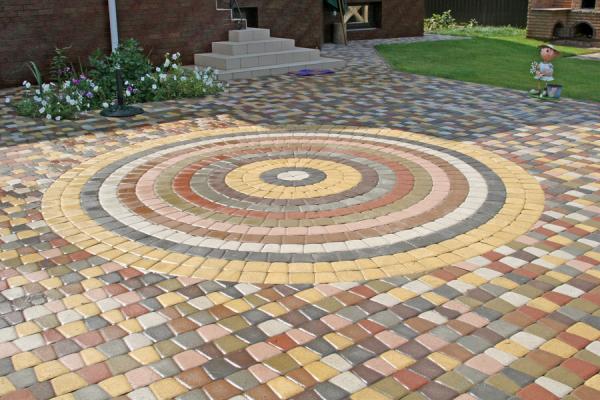
A beautifully laid path, the path will not only decorate the overall exterior of the house, but may well become its highlight. To facilitate the choice of suitable paving slabs, we will consider which types exist today, and we will use two criteria.
Types of paving slabs in the yard, or size matters
First of all, it is important to find a size convenient for your site. The simplicity of laying tracks depends on it and of course their final appearance. There are several typical sizes:
- The most convenient for giving among the types of paving slabs 50×50 (this is the blind area of the house, and the rational division of the garden into zones, and simply a fairly wide track on the lawn into one tile wide);
- the second in demand for giving among the types of paving slabs is 40×40 (usually more decorative options with a pattern in the form of a tree or stone, an excellent solution for decorating flower beds and paths near them);
- If you are interested in the types of paving slabs for decorating a large area like a yard, pay attention to the tile size of 30×30;
- And finally, the most decorative and at the same time recognizable among the types of paving slabs is 10×10 paving stones.
What types of paving slabs are there?
Now we touch on the question of a drawing or ornament on the tile. Absolutely all sizes are presented here, so there is something to choose from. Here is a list of the most recognizable drawings for us, what kind of sidewalk tiles are not there:
- Rectangular bricks, with proper styling, are similar to the pavement. The effect is achieved not by a dense neighborhood between masonry elements.
- Very often use Gzhelka. Here, one large element with curly edges is made in a square of the same four, but of a different color and smaller size.
- The so -called “cloud” is used not only for a summer house or a country house, it is often chosen for registration in public places.
- For a long time, the “clover” tile will retain its appearance. A little reminiscent of Gzhelka.
- The original solution is a tile with a flower image. It is called that. If you lay out the elements in the desired sequence, you will receive paths with images of petals.
- Another no less decorative option is a tile in the shape of a maple sheet. It can be laid in one color or alternated, it always turns out beautifully.
- For regions with frequent rains, it makes sense to choose a “parquet” tile. Its ribbed surface will not allow to slide after precipitation, and it looks interesting.
- If you have time and want to get an unusual pattern as a result, pay attention to the tile of the “honeycomb”.
- And finally, the “wave” tile, often used to decorate paths near the house.

|

|

|

|

|

|

|

|

|

|

|

|

|

|

|

|

|

|

|

|

|

|

|

|

|

|

|