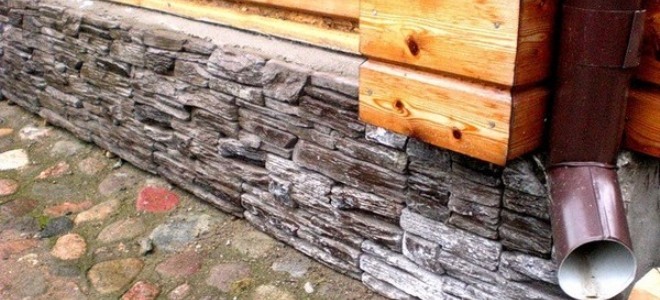
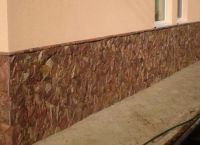
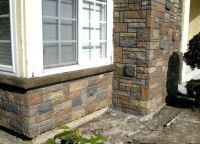
The base is the lower belt of the facade, which protects it from damage and pollution. To finish the basement of the house, the facing stone is often used, it decorates the facade of the building and serves as an excellent barrier of cold and moisture. In order to facing the lower part of the foundation, natural and artificial stone is used. A large selection of textures makes it possible to create original architectural compositions. Such a cladding goes well with brick, wooden or plastered walls.
The stone has high frost resistance, small water absorption, attracts its durability.
At the end of the cladding, it is advisable to process the base with protective impregnations, which will protect the coating from wetting during rains and will prevent the appearance of moss, mold and salts.
Natural cladding stone for the basement
Natural materials include plate, wild stone and sawn version.
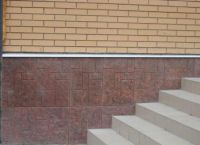
Plane is mined on workings in the mountains by chipping, it has a rather smooth surface. The material has a variety of texture, warm shades, a unique pattern. Most often, slate, sandstone, quartzite, leemesite, and shellout are used. Marble and granite are the most expensive and presentable options.
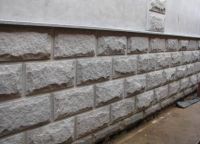
The stone is produced in the form of tiles of various sizes – a square, a rectangle, an oval or a natural non -standard. The surface of the material is smooth, polished, sawn, chopped.
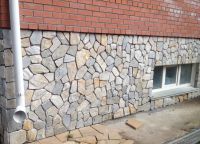
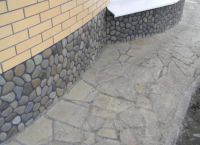
If the appearance of the stone is more textured, then it goes into the category of wild. The material is used for wall cladding, the design of flower beds, borders, water bodies.
There is also a lane stone, it differs in irregular shape and large dimensions.
It should be borne in mind that the natural material has significant weight and increases the load on the supporting structure of the house, which must be taken into account when designing the foundation.
Artificial facing stone for the basement
The finish of the base with artificial stone has gained great popularity, it is a worthy alternative to natural. The stone has a low cost in comparison with the natural one, differs in strength and excellent operational characteristics. Houses lined with artificial material are not inferior in beauty to the basement, decorated with natural stone.
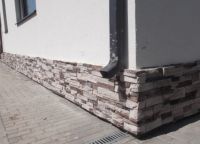
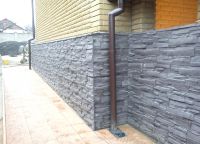
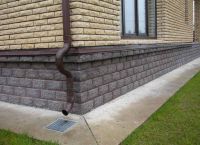
Such material has many options in the assortment. It can imitate a natural shape, processed brick, a sawn structure of the correct texture.
In the production of stone, coloring pigments can be added to it, so that the material has a large gamut of color options. Such additives can make a stone beige, gray, blue, even red. For example, natural granite has limited colors, and tiles with the addition of fillers can even have extreme burgundy or green shades. Sometimes manufacturers add iron oxide, which gives the material a fashionable effect of antiquity.
The most popular options are imitation for brick, slate, granite or rock. The surface of artificial stone can be smooth, structural, embossed. The options for finishing with a torn stone are the most popular and look unique on the building.
Artificial material has additional angular elements that make it laying simple and convenient. It is much lighter than natural stone, which significantly reduces the load on the walls.
The facade of the building will last longer and more efficiently if the stone is used in its decoration. Such material guarantees the structure of qualitative protection against mechanical influences, natural disasters and adds a mansion of solidity and presentability.
 |
 |
 |
 |
 |
 |
 |
 |
 |