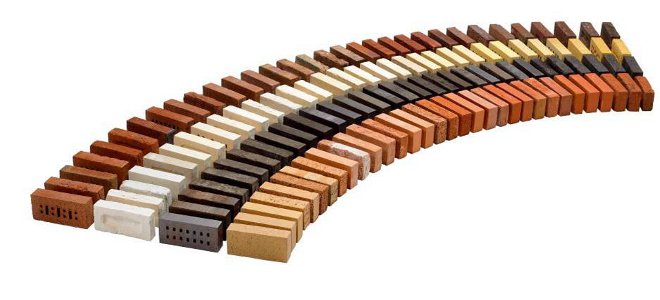
Clay has long been used for construction and finishes. With the development of technologies and the emergence of new opportunities for the market, fundamentally different building materials have entered the market. It is only for their manufacture that the same clay is used, but they achieve much better characteristics of the final product.
What does ceramic brick consist of?
Make the starting raw materials for production by the old method in quarries. The principle of manufacturing itself remained unchanged, and exclusively technologies were improved. After clay enters the plant, it begins to lay it in the extruder and the receipt of blanks. In the future, these blanks will be cut and sent for firing. High -quality products that can withstand competition consists of small fractions.
It is extremely difficult to get such a raw material, since there are few quarries left, and it turns out to remove the desired layer without mixing a single -bucket excavator. The rotary machine mixes the layers; clay with different fractions is sent for production. This makes the process of firing in such a jewelry business: you need to choose the right temperature so that fusible particles are tied to tight, and the mixture receives the necessary characteristics in the future.
A separate type is considered to be a ceramic clinker brick. The process of its production is not fundamentally different. But exclusively special refractory clay varieties are used. This tightness after the completion of all stages provides the highest strength and frost resistance. The clinker is used as a finishing option, less often it becomes ordinary. Put the wall from the clinker is expensive, but this is justified for structures intended for heavy loads.
Ceramic brick – pros and cons of
You will not meet a single building material that could boast exclusively with advantages or disadvantages. There are always two sides of the medal. This is how things are in our case, the house made of ceramic brick is “contradictory”: it has a whole list of strengths, but there are also very pleasant surprises. Knowing all the characteristics, it is easier to decide on the choice and understand whether this is the right decision.
Ceramic brick – pluses
Clay holds the palm among raw materials for construction and finishing material for a reason. With competent processing, the products are reliable and durable, they have excellent characteristics. Ceramic brick for walls during construction will delight the following qualities:
- Ceramics are at ease all manifestations of the external environment: wind, rains, sunlight and even hail are not afraid of it. If you need to get a wall or part of the house that can resist mechanical damage, feel free to prefer clinker ceramic brick. It is sometimes used as a decoration of paths, so the wall will remain in its original form for more than a dozen years.
- The walls in the house are well isolated from external noise and hold heat. The air turned out to be a reliable and absolutely free soundproof solution. It is in the voids of ordinary building materials and gives such characteristics to the wall.
- Ceramic brick practically does not absorb moisture. This is achieved by the density of the structure, it simply becomes a barrier to the penetration of any moisture. The importance of such a feature is that it directly affects the ability of the wall to maintain heat in the cold season. The minimum amount of moisture falls, as a result, destruction does not occur when it freezes.
- Do not forget about the environmental safety of ceramic bricks for laying walls. In manufacturers, after a full cycle, there are almost no emissions into the atmosphere, after building the house is also safe for humans.
Ceramic brick – Cons
As in every barrel of honey sometimes there is a spoonful of honey, and with all its advantages, ceramic tiles of brick have minor disadvantages. The numbers on the price tag in a construction store are striking in the eyes. When you are looking for a quality product with the characteristics you need, you have to agree with a high price. For the production of brown ceramic brick with a red shade of dye, it may not be needed.
But in order to obtain others that are not characteristic of clay, shades have to be taken coloring substances. As a result, the buyer plays the lottery: it is difficult to guess whether the supplier is a conscientious supplier, whether he used the dyes safe for health. If your design idea involves a decoration of white ceramic brick, it makes no sense to save. The building materials in itself are expensive, and it turns out to reduce it at the expense of pigments.
Ceramic brick for outdoor decoration
It is not necessary to build a wall of ceramics to get sufficient protective qualities for the home. For faces cladding, ceramic brick decoration is actively used. The buyer is quite expected in this matter not only of strength and thermal insulation, but also decorative components. Reduce weight a little, increase thermal insulation properties. A ceramic brick is distinguished for facing the house with accuracy of faces, an ideal surface and a pleasant eye with a look. As for the decorative side of the issue, here the buyer may well choose a suitable design for himself. Among the possible effects on the surface of ceramic bricks, manufacturers offer the following cladding options:
- the simplest solution, but not the cheapest, brick with an ordinary flat surface (the option is durable, color gamut of ceramic brick from gray to dark brown);
- The wall is much more interesting with textured effects on the surface (imitate the texture of a tree or stone, beautiful patterns – all this is appropriate in small quantities on arches or parts of the building);
- A spectacular decorative Angobus ceramic brick is distinguished by a white shade and maturity of the surface (a layer of painted white clay is applied to the base from the cheese, which gives the effect of artificial stone);
- Galusated brick tiles have a glossy ceramic surface, which is obtained after applying a layer of fusible glass and subsequent firing;
- A red ceramic brick clinker is added to this list, made from clay already familiar to us.


Types of ceramic brick
On the issue of building a wall of ceramic brick, the selected colors will play a secondary role. It is much more important to competently choose the type of ordinary or construction brick. The above was mentioned that inside the brick could be empty or filled. Both types are used in construction, everyone has its own characteristics and recommendations for specific buildings.
Ceramic brick is full -bodied
A completely filled brick boasts of enviable strength, the ability to withstand the strongest loads. It is used where thermal conductivity and sound insulation are needed, and a constant load is also planned. The weight of each unit is about 4 kg, which has to be taken into account when building on some types of soil. All of the listed qualities of complete ceramic brick will become relevant for building a basement, laying out fireplaces and furnaces. Builders build foundations and basements from it.


Ceramic hollow brick
The air inside allows you to significantly increase thermal insulation properties, but at the same time reduces strength. This is the case when the use of hollow ordinary ceramic bricks as facing is allowed. And this is far from the only option where such characteristics are useful. Ceramic brick with voids is perfect for the construction of walls of buildings up to three floors.
The house will turn out to be warm, and its cost will decrease. Partitions up to 120 mm thick are quite successfully built, they are not heavy and preserve sound insulation. Even garages or similar buildings are successfully built from hollow building materials. But all this will work provided that the buildings are far from the water. Moisture is absorbed more, and over time, the construction begins to collapse due to water inside the voids. The use of hollow ceramic bricks and in the construction of furnaces is not welcome. He simply will not allow the heat to disperse throughout the room.